
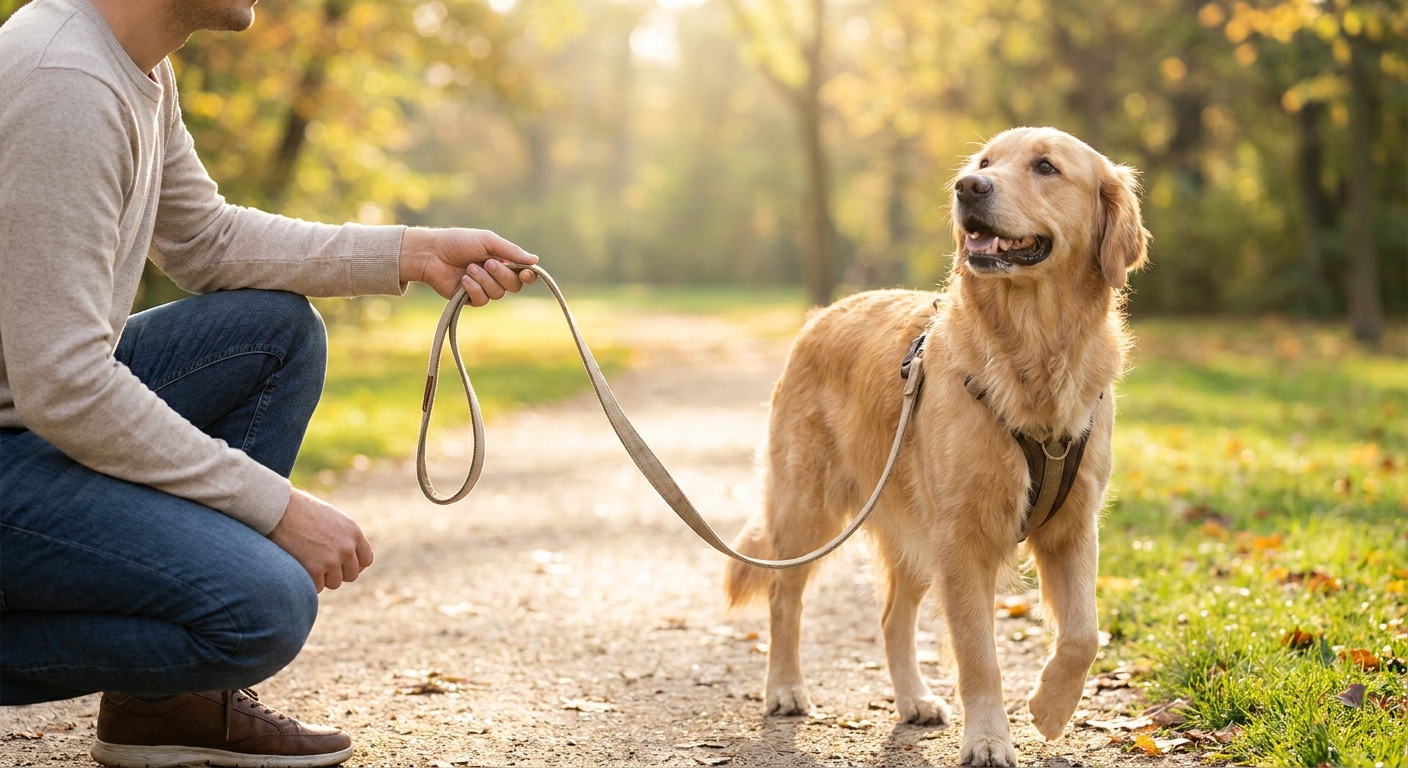
Loose lead walking is the single most requested fix from dog owners across Ashtead, Epsom, Leatherhead and the rest of Surrey, and it's trainable in most dogs within 2-4 weeks of consistent daily practice.
- Teaching a dog to walk on a loose lead takes 10-15 minutes of daily practice over 2-4 weeks for most breeds in 2026.
- High value treats and a stop-start technique outperform head collars alone for permanent loose lead walking habits.
- Practising in a low-distraction garden or driveway first cuts training time roughly in half versus starting on a busy street.
- Proud Dog’s 1:1 reward-based sessions fix pulling faster than group classes for dogs with an established pulling habit.
Why this matters
A dog that pulls on lead isn't being naughty, it's doing what's worked every single walk since puppyhood: pull, get somewhere faster, get rewarded by forward motion. Every walk where the pulling gets your dog to the lamppost, the other dog, or the park gate reinforces the exact behaviour you're trying to remove.
The fix isn't a stronger lead or a different collar, it's changing what gets rewarded. Dogs repeat what works and is rewarding. Make loose lead walking and staying close by be the things that move the walk forward, and pulling stops being desirable within a few weeks.
Most owners who contact Proud Dog for loose lead walking help in 2026 have already tried a slip lead, a harness swap, or shouting "heel" on repeat. None of those fix the underlying reinforcement pattern, this guide covers one of a variety of methods to do this.
What you'll need
- A well fitted Y shaped harness, ideally with front and back clips, or a flat collar (nothing that tightens if they pull)
- A standard 1-2m fixed lead , no t an extendable one.
- Small, high value treats cut to pea-size . Things like chicken, cheese, or a commercial training treat
- A treat pouch or accessible pocket so you're not fumbling mid-walk
- 10-15 minutes a day
- A quiet space to start. A garden, driveway, or empty car park, not a busy pavement
The steps
1. Start in a distraction-free space
Begin in your garden or driveway, not on the street. Dogs can't learn a new skill while their brain is also processing traffic, other dogs, and smells at the same time.
Clip the lead on and just stand still. Wait for your dog to glance at you or take a step in your direction, then mark it with a treat. This teaches your dog that checking in with you is worth something before a single step of walking happens.
Common mistake: starting the actual walk on day one. Give your dog at least two or three short sessions of standing-still engagement before you move anywhere.
2. Use the stop-start technique
Walk forward. The instant the lead goes tight, stop dead. Don't pull back, don't say anything, just become a statue. Wait for slack to return to the lead (your dog will usually turn back or sit), then reward and move forward again. If this doesn't happen naturally, then use a treat to guide them around in a circle back to your side.
This is the core mechanic of loose lead walking. Your dog learns in real time that a tight lead makes the walk stop, and a loose lead makes the walk continue. Repeat this dozens of times per session. It may feel slow, but it's worth the effort.
Expected outcome: by session five or six, most dogs start self correcting before the lead goes fully tight.
3. Reward position, not just behaviour
Don't just wait for pulling to stop, you should actively reward your dog for walking in the position you want too, roughly level with your leg. Use a marker word like 'Yes!' and feed your dog a treat at your side every 3-5 steps when the lead is loose.
This is where most owners go wrong, because they usually punish the pulling and just feel relief at the absence of pulling, rather than actively rewarding the good walking. Reward the position you want to see, and your dog starts choosing it on its own.
4. Add direction changes
Once your dog holds a loose lead in a straight line for 10-20 metres, you can start adding turns. Change direction away from them (so if they are on your left, turn right, otherwise you'll trip over them!)and encourage them to follow..
This builds the habit of watching you rather than fixating on what's ahead. It also mimics real walks, which are never a straight line for long. If your dog pulls into the turn, stop and reset using the stop-start technique from step 2.
Common mistake: only ever practising in a straight line, then wondering why the dog falls apart at the first junction on a real walk.
5. Introduce mild distractions
Move to a quiet residential street. Practise walking past a parked car, a lamppost, a person on the other side of the road. Keep sessions at 5-10 minutes so your dog doesn't burn out mentally before the walk even properly starts.
If your dog struggles, you've moved up a level too fast. If that happens, go back to the garden for another two or three sessions before trying the street again.
6. Build up to real-world triggers
Gradually work toward the actual triggers that cause pulling, other dogs, squirrels, joggers, cyclists. Keep distance generous at first, enough that your dog notices the trigger but can still respond to you. You can also choose particular sections of the walk to train on at first, again keeping it to 5-10 minutes, to get them used to working around distractions.
Reward heavily every time your dog chooses you over the trigger. This is the step that separates dogs who walk nicely in the garden from dogs who walk nicely everywhere, and it's usually where owners need the most hands-on guidance because timing matters more here than anywhere else.
7. Fade the constant treating
Once loose lead walking is reliable across most environments, start rewarding intermittently rather than every few steps. Praise still happens all the time and food rewards become occasional and unpredictable.
This locks the behaviour in for the long term. A dog rewarded on a random schedule keeps offering the behaviour hoping this time is the payout, which is exactly the pattern that makes loose lead walking stick.
Struggling to get past the pulling stage?
1:1 reward-based sessions across Surrey fix stuck pulling habits faster than solo practice.
Troubleshooting
- My dog sits down and refuses to move on a loose lead. This is often a dog that's confused about what earns the reward, not a stubborn dog. Go back to step 1 and reward any forward step, however small, for a session or two.
- My dog is fine in the garden but pulls immediately on the street. The jump in difficulty was too big. Add an intermediate step like a quiet driveway walk, or the street at a quiet time of day, before attempting a normal walk.
- My dog pulls only toward other dogs, otherwise walks nicely. This is a specific trigger issue, not a general loose lead problem. Practise step 6 specifically with dog sightings at a distance your dog can handle without losing focus.
- Progress stalled after week two. Check your reward rate. Most owners under reward once early progress happens. Go back to rewarding every 3-5 steps for a few sessions before fading again.
- My dog pulls harder when excited (start of walk, seeing the lead). Practise the stop-start technique from the front door itself. If your dog pulls before you've even left the house, the lead never gets slack to move forward until it settles. You can also do calming activities or other training before leaving the house to get them more focussed.
- Multiple dogs in the household make this harder. Train each dog separately on lead before attempting loose lead walking together. Mixing an untrained dog with a trained one usually drags the trained dog backward.
Tools and resources
- A Y shaped harness or flat collar sized correctly
- A treat pouch that clips to your waistband, freeing both hands for lead handling and rewarding
- Short sessions to start – dogs learn faster from short, consistent sessions than long, irregular ones
- 1:1 support from Proud Dog if pulling has been an established habit for months rather than weeks. A trained eye spots timing issues that are hard to catch on your own
What to do next
If your dog is walking on a loose lead in the garden and quiet streets but still falls apart around other dogs or on busy routes, the next skill to build is recall. A dog that reliably comes back to you off lead also tends to check in with you more consistently on lead. Dogs with a strong pulling history built up over months or years usually progress faster with hands-on 1:1 guidance than with solo practice alone, particularly around the distraction and real world trigger stages.
FAQ
How long does it take to train a dog to walk on a loose lead?
Most dogs learn loose lead walking basics in 3-6 weeks of daily 10-15 minute sessions. Dogs with an established pulling habit built up over months can take 6-8 weeks with consistent practice.
What’s the best harness for loose lead training?
A well-fitted Y shaped harness with a front and back clip works best for most dogs learning loose lead walking, as it allows for more control and comfort.
Is a head collar better than a harness for loose lead walking?
A head collar can help manage pulling in the short term but doesn’t teach the underlying behaviour on its own. It can also be very uncomfortable for your dog. Pairing any equipment with training gets faster, more permanent results than the head collar alone.
Why does my dog pull only near other dogs?
This is a specific trigger response rather than a general loose lead problem. Practising at a distance your dog can handle, then gradually closing the gap, resolves it faster than avoiding other dogs entirely.
Should I use treats forever to keep my dog walking on a loose lead?
Trained properly, that won’t be necessary. Treats get faded to an intermittent, unpredictable schedule once the behaviour is reliable, usually by week 4 or 5. Praise continues every time, but constant food rewards aren’t needed long term.
Can an older dog learn to walk on a loose lead?
Yes! Dogs of any age can learn loose lead walking, though older dogs with years of pulling habit typically need a longer, more gradual training period. The same stop-start and reward-position techniques apply regardless of age.
What size lead is best for loose lead training?
A standard 1-2m fixed lead works best for loose lead training, depending on the size of the dog. Extendable leads should be avoided entirely during training since they reward pulling by extending automatically.
When should I get professional help for lead pulling?
Get 1:1 support if pulling hasn’t improved after 3-4 weeks of consistent daily practice, or if the behaviour is paired with reactivity toward other dogs or people. A trained eye can spot timing mistakes that are hard to self-diagnose.
One last thing
The dogs that regress fastest after initial loose lead success aren't being difficult or untrainable, it's usually because owners stop practising the moment pulling stops. Keep two or three short reinforcement sessions a week going, even after your dog seems fully trained, and the habit holds for good instead of quietly unravelling over a few missed months.

