
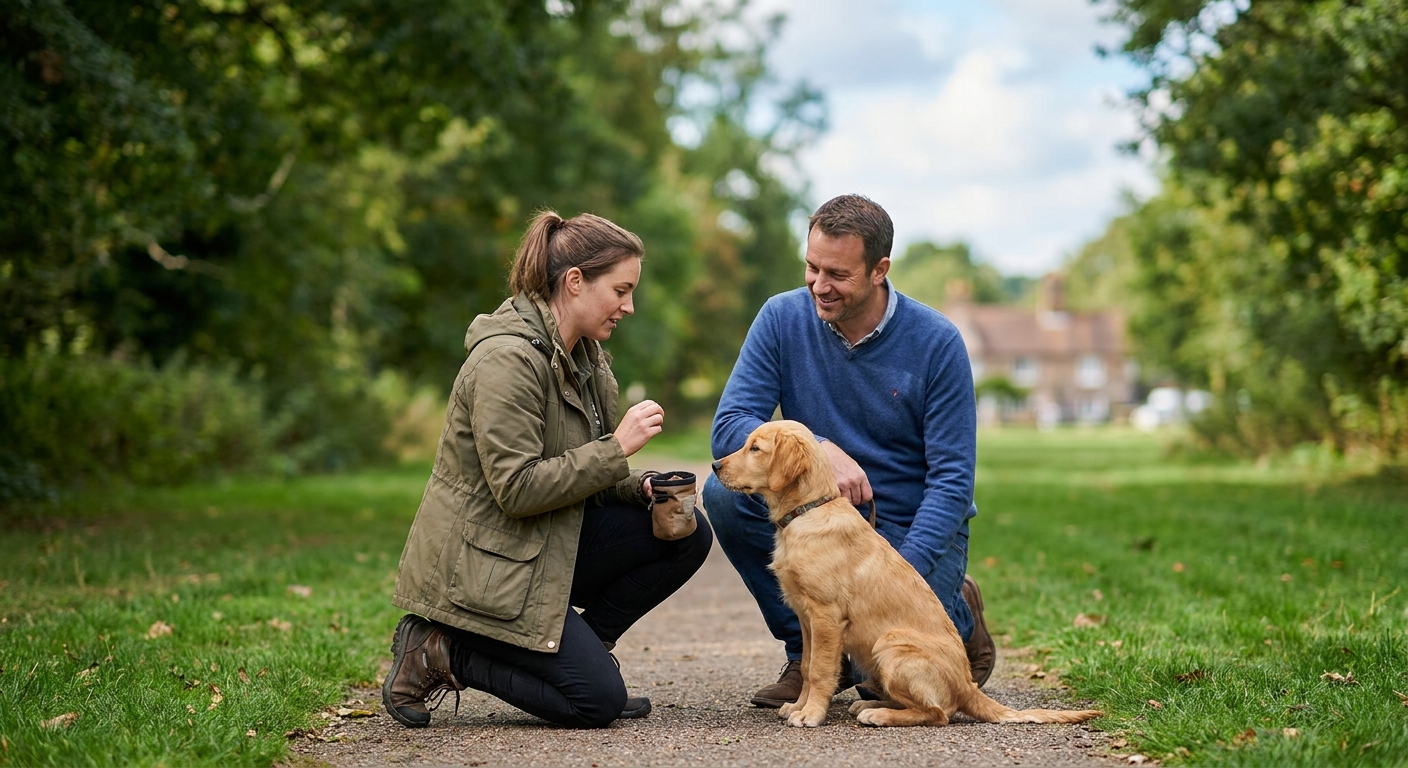
If you're in Banstead and your dog turns into a lead-yanking, doorbell-triggered whirlwind every time you leave the house, group puppy class handouts aren't going to fix it. One-to-one dog training built around your dog's specific triggers gets you further than a generic six-week course ever will, and it's the approach Proud Dog uses across Banstead and the surrounding Surrey towns.
- Dog training Banstead owners can trust starts with 1:1 sessions matched to your dog, not a generic six-week course.
- Proud Dog trainers hold ABTC and PACT credentials and use reward-based methods only, no corrections or e-collars.
- Recall, loose lead walking and jumping up each need different fixes – bundling them into one package rarely works.
- Sessions happen in your home and local Banstead environment, not a training hall miles away in 2026.
Why this matters
A dog that pulls like an Olympic sled dog on the school run or turns into a Tasmanian devil when guests arrive isn't being naughty – it's practising a behaviour that's being rewarded somehow, even accidentally. Group classes teach general obedience in a controlled room; they don't touch what happens on your actual Banstead high street with real distractions.
One-to-one work fixes that gap. The training happens where the problem happens, at a pace built around your dog's specific triggers, in 2026 with methods that don't rely on fear or corrections to get results.
Who this is for
This is for Banstead dog owners who've tried a Saturday morning class and found it doesn't transfer to real life – the dog sits beautifully in the hall and ignores you completely on Park Road. It's also for new puppy owners who want to get ahead of problems before they set in, and for owners of adolescent or rescue dogs dealing with reactivity, jumping up, or recall that vanishes the second a squirrel shows up.
What to look for in dog training for Banstead dog owners
Reward-based methods, not corrections
Any trainer offering "quick fixes" with prong collars, e-collars, or dominance-based corrections is treating the symptom, not the cause. Reward-based training works because dogs repeat what gets reinforced within about 3 seconds of the behaviour – timing and consistency matter more than punishment ever will.
Genuine 1:1 sessions, not a repackaged group class
Some "private training" is just a group class curriculum delivered one dog at a time. Real 1:1 work adapts the plan session to session based on what your specific dog is struggling with that week.
Recognised qualifications
Look for ABTC (Animal Behaviour and Training Council) registration or PACT membership. These aren't marketing badges – they mean the trainer has been assessed against a professional standard, not just watched a few YouTube videos.
Programmes matched to the specific behaviour
Recall, loose lead walking, and jumping up are three different problems with three different training plans. A trainer who treats them all the same way hasn't diagnosed what's actually driving your dog's behaviour.
Local knowledge of Surrey environments
A trainer who knows Banstead's parks, the busier stretches near the high street, and where dog traffic is heaviest can build a recall plan around real distractions, not a quiet field that doesn't exist near your house.
Sessions that come to you
Training in your own home and local streets means the dog learns to behave where it actually lives, not just inside a training centre it visits once a week.
Book 1:1 dog training in Banstead
Reward-based sessions built around your dog, in your own home and local area.
Proud Dog's programmes for Banstead owners
Puppy Foundations – the safe pick. Covers socialisation during the critical window that closes around 16 weeks, when puppies are most open to new people, dogs, noises and environments. Get this window right and you spend 2026 managing a confident dog instead of firefighting fear-based reactivity later. Buy.
Recall training – the one most owners wait too long to book. This targets off-lead reliability around real distractions: other dogs, joggers, wildlife on Banstead's open spaces. If your dog currently treats "come here" as a suggestion, this is the programme that changes that. Buy.
Loose lead walking – the Olympic sled puller fix. Built for dogs that turn every walk into a tug of war, this rebuilds the walk from scratch using reward timing rather than a tighter collar or a sharper correction. Buy.
Jumping up and greeting manners – the doorbell chaos fix. Useful if your dog turns into a Tasmanian devil the second guests or the postman arrive. Less urgent than recall or lead work if your dog is otherwise settled, so it's a fair one to sequence in after the bigger issues are handled. Consider.
What to avoid
- Group classes for reactive or anxious dogs. Peer pressure from other dogs in the room can make reactivity worse, not better, and there's no room for individual attention.
- Unnamed "training packages" sold online with no visible trainer credentials. If you can't find ABTC or PACT registration for the person running the sessions, you're taking a gamble on methodology.
- Aversive tools marketed as shortcuts. Prong collars and e-collars suppress behaviour through discomfort rather than teaching the dog what to do instead – the behaviour often returns, sometimes worse, once the tool comes off.
Verdict comparison
| Criteria | Why it matters | Proud Dog's approach | Verdict |
|---|---|---|---|
| Training method | Reward-based work builds lasting behaviour change | Reward-based only, no corrections | Buy |
| Session format | Group classes rarely transfer to real-world triggers | Genuine 1:1, tailored per dog | Buy |
| Qualifications | Confirms professional standard, not guesswork | ABTC and PACT registered | Buy |
| Location | Training in real environments beats a training hall | In-home, across Banstead and Surrey | Buy |
| Programme fit | One plan doesn't fix recall, lead walking and jumping up equally | Separate plans per behaviour | Buy |
FAQ
What’s the best dog training in Banstead?
The best option for most Banstead owners is 1:1, reward-based training matched to a specific problem like recall or loose lead walking, rather than a general group class. Proud Dog runs these sessions locally across Banstead and nearby Surrey towns.
Is 1:1 dog training better than group classes for Banstead dogs?
For behaviour problems like reactivity, jumping up or poor recall, yes – 1:1 training adapts to your dog’s actual triggers in real environments. Group classes work well for basic socialisation but rarely fix specific behaviour issues on their own.
How much does dog training cost in Banstead in 2026?
Costs vary depending on the programme and number of sessions needed, so it’s worth checking current pricing directly with the trainer. Ask what’s included per session rather than comparing headline prices alone.
Can a Banstead trainer help with recall only?
Yes, recall can be worked on as a standalone programme separate from lead walking or jumping up. Most trainers will build a plan around the specific distractions your dog struggles with, like joggers or other dogs.
Do I need to travel to a training centre for sessions?
No, 1:1 dog training in Banstead typically happens in your own home and local streets, which is more useful than a training hall since your dog learns to behave where it actually lives. This also removes travel time for owners across Epsom, Leatherhead and Ashtead.
Is reward-based training effective for older or rescue dogs?
Yes, reward-based methods work at any age because dogs continue learning through reinforcement throughout their lives. Older and rescue dogs often need a slower pace and more patience, but the underlying method doesn’t change.
What qualifications should a dog trainer near Banstead have?
Look for ABTC (Animal Behaviour and Training Council) registration or PACT membership as a minimum. These confirm the trainer has been assessed against a professional standard rather than relying on informal experience alone.
How long before I see results with loose lead walking?
Most owners notice a difference within the first few sessions once the reward timing is consistent, though full reliability around distractions takes longer. Progress depends on how established the pulling habit is and how consistently the plan is followed between sessions.
One last thing
The puppy socialisation window closes around 16 weeks and never reopens – miss it, and you spend the rest of 2026 managing fear-based behaviour instead of preventing it in the first place. If your puppy is still under that age, book something now rather than waiting to see if it "grows out of it."

