
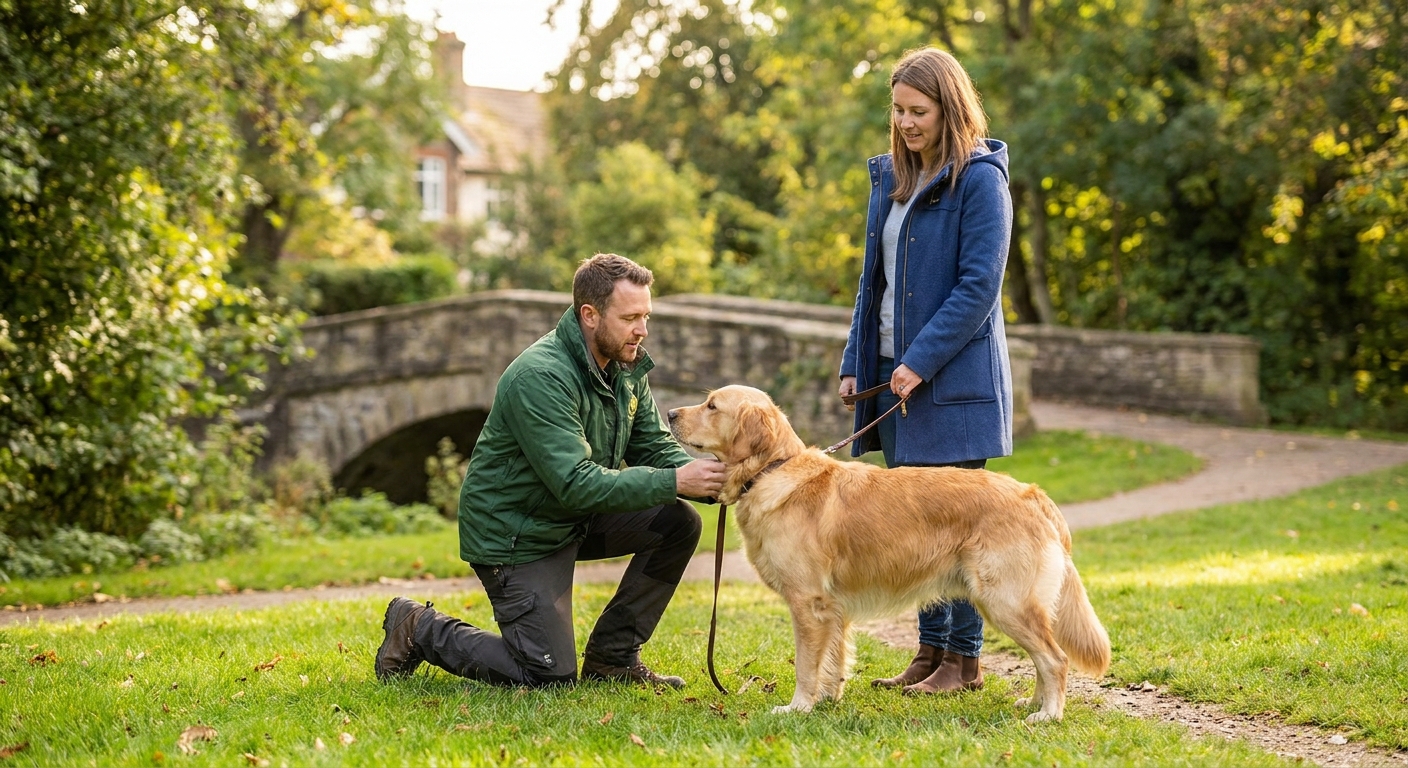
If you're searching "dog training Leatherhead" at 11pm because your dog just bolted after a squirrel again, this is written for you. It covers what 1:1 training actually looks like for Leatherhead owners, what to check before booking a trainer, and where reward-based work makes the biggest difference.
- Proud Dog runs 1:1 dog training in Leatherhead using reward-based methods, not group classes.
- Recall and loose lead walking are the two most-requested programmes for Leatherhead owners in 2026.
- Puppy foundations sessions start from 8 weeks old and run for 30-45 minutes.
- Skip trainers who lean on choke chains or dominance language — ABTC and PACT accreditation is the marker to check.
- Book a call before committing to a block of sessions so the plan matches your dog, not a template.
Why this matters
Leatherhead has a specific mix of challenges: busy pavements near the town centre, off-lead temptation on the commons and riverside paths, and a lot of families juggling school runs with a young dog that hasn't learned recall yet. Generic online advice doesn't account for any of that.
1:1 dog training with Proud Dog is built around your dog, your street, and your actual daily walk — not a training hall thirty minutes away. That's the difference between a dog that sits nicely indoors and a dog that comes back when called near the Mole at Leatherhead.
In 2026, more Leatherhead owners are choosing 1:1 sessions over group classes because behaviour problems — jumping up at visitors, pulling like an Olympic sled dog, ignoring recall — rarely get solved in a room full of distractions. They get solved on your actual walk, with a plan built for your dog.
Who this is for
This is for Leatherhead owners with a puppy under a year old who needs foundations, or an adult dog with a specific habit that's wearing you down — pulling on the lead, jumping on guests, or vanishing the second the lead comes off. It's also for anyone who's tried a generic six-week class and found their dog is "fine in the hall, chaos outside."
It is not for owners looking for a quick fix in one session. Reward-based behaviour change takes repetition, and most programmes run over several weeks, not one visit.
What to look for in dog training for Leatherhead owners
Reward-based methods, not correction-based ones
Dogs trained with reward-based methods learn faster and retain it longer because they're working for something they want, not avoiding something they fear. If a trainer mentions choke chains, prong collars, or "showing the dog who's boss," that's a red flag in 2026, not a training style.
Sessions held on your actual streets, not a hall
A dog that sits perfectly in a training room can still bolt on Bridge Street. Sessions that happen where you actually walk — Leatherhead's commons, the high street, your own garden — transfer far better than a generic classroom setting.
A trainer with recognised accreditation
Look for ABTC (Animal Behaviour and Training Council) registration or PACT membership. These aren't marketing badges — they mean the trainer has been assessed against a professional standard, which matters when you're trusting someone with your dog's behaviour plan.
A plan matched to your dog's age and history
An 8-week-old puppy and a 3-year-old rescue with a bite history need completely different approaches. A trainer who offers the same six-week package to every dog regardless of age or background isn't tailoring anything.
Clear, realistic timelines
Most recall problems improve noticeably within 4-6 sessions of consistent work, not one visit. Be wary of anyone promising a fixed dog in a single session — behaviour change takes repetition, and honest trainers say so upfront.
Support between sessions
A one-off visit with no follow-up plan rarely sticks. Ask whether you get guidance to practise between sessions, since that's where most of the actual behaviour change happens.
Top picks: which programme fits your dog
Puppy foundations — the head-start pick. Starts from 8 weeks old, covering house training, socialisation, and the basics before bad habits form. Sessions typically run 30-45 minutes and focus on preventing problems rather than fixing them later. Buy if your puppy is under 20 weeks — this window is the cheapest and fastest time to build good habits.
Recall training — the off-lead confidence pick. Built for dogs that ignore their name the second they spot another dog or a squirrel near Leatherhead's open spaces. Most owners see a real shift within 4-6 sessions of consistent practice. Buy if you're currently keeping your dog on lead out of fear they won't come back.
Loose lead walking — the sled-dog fix. For the dog that turns every walk into an arm workout. Sessions focus on rebuilding the walk from scratch rather than just correcting the pull. Consider this if pulling is your only issue and recall is already solid — otherwise bundle it with recall work.
Jumping up and greeting manners — the doorbell chaos pick. For dogs that turn every visitor into a Tazmanian devil moment. Works on impulse control around excitement, not just "no." Consider if this is embarrassing rather than dangerous; prioritise recall first if your dog also runs off.
Reactivity and behaviour consults — the deeper-issue pick. For dogs showing fear, frustration, or reactivity toward people or other dogs on lead. These need a proper behaviour assessment before any training plan starts. Buy if you've noticed growling, lunging, or freezing — don't wait for it to escalate.
What to avoid
- One-size-fits-all group classes that put an anxious dog next to a boisterous adolescent with no individual attention — looks affordable, rarely fixes specific problems.
- Trainers who guarantee results in one session — real behaviour change in 2026 still takes weeks of consistent practice, not a single visit.
- Anyone using dominance language ("alpha," "pack leader," "showing them who's boss") — this framing is outdated and tends to pair with correction-based tools.
“What matters most isn’t where your dog went wrong — it’s how we move forward from here.”
Verdict comparison
| Programme | Best for | Typical length | Verdict |
|---|---|---|---|
| Puppy foundations | Puppies under 20 weeks | 30-45 min sessions | Buy |
| Recall training | Off-lead confidence | 4-6 sessions | Buy |
| Loose lead walking | Pulling on walks | Bundled with recall | Consider |
| Jumping up / manners | Greeting chaos | Bundled programme | Consider |
| Reactivity consult | Fear or lunging | Assessment-led | Buy |
Book 1:1 training in Leatherhead
Get a plan built around your dog and your streets, not a generic class.
FAQ
What’s the best dog training option in Leatherhead?
1:1 reward-based training held on your own streets and in your home tends to outperform group classes for specific problems like recall or pulling. It lets the trainer tailor the plan to your dog’s age, history and the actual places you walk, rather than a generic hall setting.
Is 1:1 training better than group classes?
For a specific behaviour issue, yes — 1:1 sessions let a trainer address your dog’s exact triggers without the distraction of other dogs. Group classes work better for general socialisation once foundational issues are already sorted.
How long does it take to fix recall in a dog?
Most dogs show a noticeable improvement within 4-6 consistent sessions, though full reliability off-lead can take longer depending on the dog’s history and how often you practise between sessions. Consistency between visits matters more than the number of sessions itself.
At what age should puppy training start?
Puppy foundations can start from around 8 weeks old, covering house training, socialisation and basic manners before habits set in. Starting early in 2026 is cheaper and faster than correcting an established habit at 12 months.
Do trainers need accreditation to be trusted?
Look for ABTC registration or PACT membership — both indicate the trainer has been assessed against a professional standard rather than self-certified. It’s a more reliable signal than testimonials or years in business alone.
Can 1:1 training help with jumping up on visitors?
Yes, jumping up is typically an impulse-control issue rather than a dominance issue, and it responds well to reward-based work around greetings. Sessions usually combine management (like a lead by the door) with training the calmer alternative.
Is reward-based training slower than correction-based training?
No — dogs trained with rewards tend to retain behaviours longer and show fewer fear-based side effects than dogs trained with corrections. The pace is comparable; the difference is in what sticks and what fallout follows.
What areas around Leatherhead does 1:1 training cover?
Coverage typically extends to Ashtead, Epsom, Cobham, Oxshott, Dorking and other Surrey towns near Leatherhead, with sessions held at your home or on your usual walking routes rather than a fixed venue.
One last thing
The dogs that improve fastest in 2026 aren't the calmest ones — they're the ones whose owners practise for five minutes, three times a day, rather than one long session once a week. Short, frequent repetition beats a single 45-minute slog every time, and it's the one piece of advice that separates a dog that "sort of" listens from one that reliably does.

