
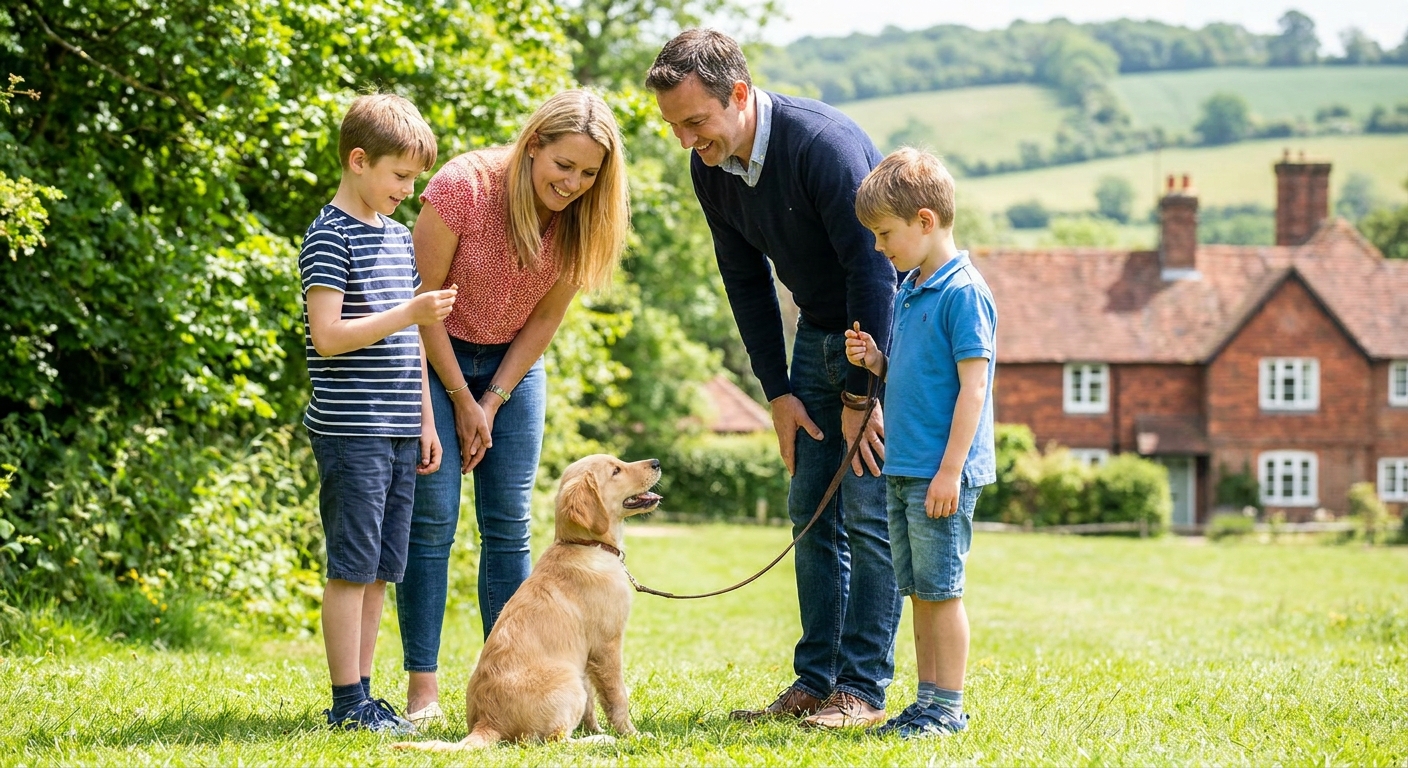
Puppy training in Leatherhead isn't the same job as training a puppy in a flat in Zone 2 — you've got the school run, the walk into town, and a garden that backs onto three other gardens with three other dogs losing their minds at the fence. Here's what actually separates a puppy training plan that sticks from one that falls apart by week six.
- 1:1 reward-based puppy training in Leatherhead beats generic group classes for families juggling school runs and clubs — Buy.
- The puppy socialisation window narrows sharply after 16 weeks, so book training before month four, not after.
- Board-and-train kennels skip the hands-on learning that puppy training leatherhead families actually need at home — Skip.
- Online-only puppy courses can’t fix jumping-up or recall in real gardens and parks across Ashtead, Epsom or Cobham — Consider as a supplement only.
Why this matters
A puppy's brain is doing its most important social learning between roughly 3 and 16 weeks old. Miss that window with the wrong approach, and you're not just delaying good manners — you're building fear responses that take months to unpick later. Families in Leatherhead have more choice than most: group classes, online courses, board-and-train kennels, and 1:1 trainers who'll come to your house. The choice matters more than people think, because a puppy that learns recall in a quiet training hall often has no idea what "come" means on Leatherhead's Common with a squirrel involved.
Who puppy training in Leatherhead is actually for
This is for families with a puppy under 12 months who need training that fits around school pickup, after-school clubs, and a household where more than one person handles the lead. It's for owners who've googled "puppy jumping up on visitors" at 11pm and want a plan that doesn't involve shouting. It's not for anyone chasing a quick fix — puppies don't learn in one session, whatever a kennel brochure promises.
What to look for in puppy training for Leatherhead families
Flexibility around your actual week
A training slot that only works at 2pm on a Tuesday is useless if both parents work and the kids have swimming. Look for a trainer who'll fit sessions around your household, not the other way round. Leatherhead families juggle enough logistics without adding a fixed class time that clashes with everything else.
Reward-based methods, not dominance
Older-style "pack leader" training relies on corrections and intimidation, and it tends to produce a puppy that's compliant out of fear rather than one that's genuinely settled. Reward-based training builds trust — the puppy chooses to come back to you because good things happen, not because it's scared not to. This matters even more with a family dog that needs to be relaxed around children, not just obedient to one adult.
Real-world practice, not just a training hall
A puppy that sits perfectly in a quiet room can fall apart completely on Leatherhead High Street with buses, prams, and other dogs. Training that happens in your actual environment — your garden, your street, your local park — transfers far better than a sterile classroom. Ask whether sessions happen at home and out on real walks, not just indoors.
Accredited, qualified trainers
Anyone can call themselves a dog trainer — there's no legal requirement for qualifications in the UK. Look for accreditation through bodies like the ABTC (Animal Behaviour and Training Council) or PACT, which set standards for humane, evidence-based methods. It's the difference between advice grounded in animal behaviour science and advice grounded in what worked on someone's dog in 2003.
Whole-family involvement
If only one parent learns the training cues, the puppy gets confused fast when someone else handles the lead. Good puppy training includes the kids and both parents, so everyone's using the same words and the same approach. A puppy that only listens to one person isn't actually trained — it's just bonded to one person.
Book 1:1 puppy training in Leatherhead
Reward-based sessions at home and out on real walks, fitted around your family’s week.
Top picks for puppy training leatherhead families
1:1 reward-based puppy training — the safe pick. Sessions come to your house and out onto your actual streets and parks, so the puppy practices recall and loose lead walking in the places you'll actually use them, not a rented hall. Proud Dog's 1:1 puppy training covers jumping up, recall and loose lead walking as a programme built around your household, with sessions arranged around school runs rather than a fixed weekly slot. Families with young kids benefit most, because everyone in the house learns the same cues together. Verdict: Buy.
Local group puppy classes — the social pick. Typical group classes run 6-8 puppies per session for around an hour, which gives useful early socialisation but very little individual correction time — do the maths and each puppy gets roughly 7-8 minutes of direct attention across an hour. Good for exposure to other dogs early on, weak for fixing a specific problem like a puppy that won't come back on the Common. Verdict: Consider as an add-on, not your only training.
Online puppy training courses — the backup plan. These work fine for teaching a sit or a down in a quiet kitchen, but a screen can't watch your puppy lunge at a jogger and correct the timing in real time. Loose lead walking and recall are almost entirely about timing, and a pre-recorded video has none. Verdict: Consider only alongside in-person work, never instead of it.
Board-and-train kennels — the shortcut that isn't. Sending a puppy away for two weeks might produce a dog that behaves for the trainer, but the family never learns the cues, so the good behaviour often unravels within days of coming home. It also skips the bonding and confidence-building that happens when a puppy learns alongside the people it lives with. Verdict: Skip.
What to avoid
- Dominance-based advice — anything involving alpha rolls, forced eye contact, or "showing the puppy who's boss" is outdated and tends to increase anxiety rather than fix behaviour.
- One-size-fits-all six-week courses with no home visits — a puppy that only ever trains in one room learns a room, not a set of skills.
- Trainers with no visible accreditation — ask directly whether they're registered with the ABTC or PACT before booking anything.
Verdict comparison
| Option | Fits around your week | Real-world practice | Whole family involved | Verdict |
|---|---|---|---|---|
| 1:1 reward-based training | Yes | Yes, at home and on walks | Yes | Buy |
| Group puppy classes | Fixed weekly slot | Limited, hall-based | Partial | Consider |
| Online courses | Fully flexible | No | Partial | Consider |
| Board-and-train kennels | No, 1-2 week block | Yes for the trainer, not you | No | Skip |
FAQ
What’s the best puppy training option for Leatherhead families?
1:1 reward-based puppy training that comes to your home and out onto local streets and parks works best for most Leatherhead families in 2026, because it fits around school runs and involves the whole household rather than one parent. Group classes and online courses can supplement this but rarely replace it.
When should puppy training start?
Puppy training should start as soon as your puppy is home, ideally by 8-12 weeks old, while the socialisation window is still wide open. Waiting until behaviours like jumping up or ignoring recall are established makes them slower to unlearn.
Is 1:1 training better than group puppy classes?
1:1 training is better for fixing specific problems like recall or loose lead walking, because a trainer can watch and correct timing in your actual environment. Group classes are useful for early socialisation with other puppies but give minimal individual attention per dog.
How much does puppy training cost in Surrey?
Pricing varies by trainer and programme length, so check current rates directly with the provider rather than relying on a fixed figure. Compare what’s included — home visits, real-world walks, family sessions — rather than price alone.
Can puppy jumping up be fixed without shouting or corrections?
Yes, reward-based methods teach a puppy an alternative behaviour, like sitting for greetings, so jumping up stops being rewarding. This tends to work faster and more reliably than corrections, which can make an excitable puppy more wound up rather than less.
Do board-and-train kennels work for puppies?
Board-and-train can produce short-term compliance with the trainer, but the family rarely learns the same cues, so behaviour often slips once the puppy is back home. Training that includes the owners tends to hold up far better long-term.
What should I check before booking a puppy trainer?
Check for accreditation through the ABTC or PACT, ask whether sessions happen at home and outdoors rather than only in a hall, and confirm the whole family can take part. A trainer using outdated dominance-based language is a red flag regardless of price.
Does loose lead walking training work on real walks or just in training halls?
Loose lead walking only really transfers when it’s practiced on the streets, parks and pavements you’ll actually use, not just a quiet indoor space. Ask any trainer whether sessions include real walks around Leatherhead, not just classroom time.
One last thing
The socialisation window that matters most closes around 16 weeks, and it doesn't reopen — whatever training route you pick, the clock is already running the day you bring the puppy home. Families who wait until a problem is fully formed, like a six-month-old that won't come back off-lead, are doing harder, slower work than families who book training in month two. Start earlier than feels necessary; it's always cheaper in time than starting late.

