
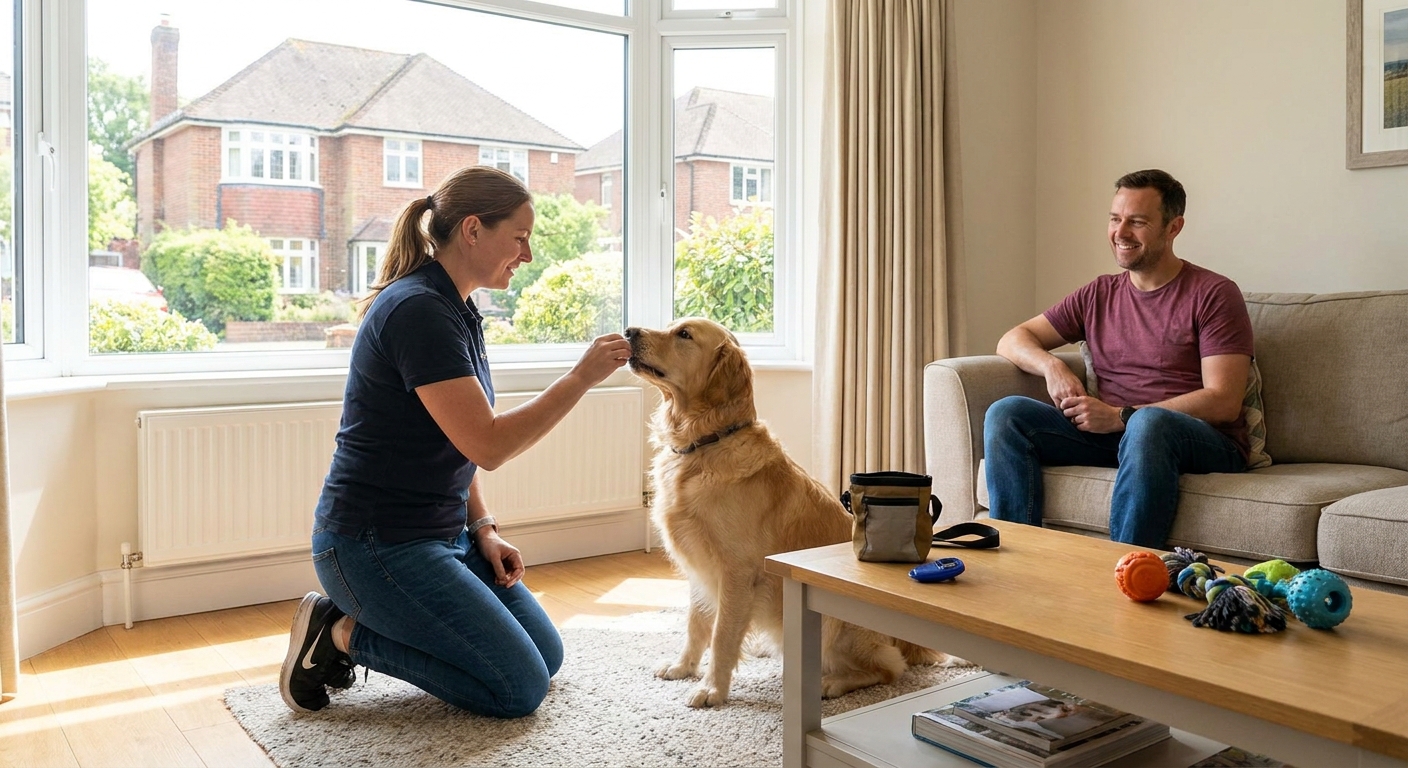
Surrey dog owners have five realistic ways to get professional training in 2026: 1:1 in-home coaching, group puppy classes, board-and-train kennels, video-call coaching, and self-guided apps. Here's which one actually fixes recall, loose lead pulling and jumping up, and which one wastes your money.
- 1:1 in-home dog training wins for Surrey owners tackling recall, jumping up or loose lead pulling in 2026.
- Group puppy classes help with socialisation but rarely fix a specific one-on-one behaviour problem.
- Board-and-train kennels train the dog away from home, so the fix often doesn’t survive the drive back.
- Video-call coaching suits mild issues with a confident owner; it can’t intervene physically when things go wrong.
- DIY apps cost nothing but give zero feedback on whether you’re doing it right.
Why this matters
Most training advice online is generic. It's written for a flat somewhere, not a semi-detached in Ashtead with a spaniel who loses his mind at the postman, or a lead-puller in Epsom who's fine in the garden and a nightmare on the high street.
The format you choose matters as much as the trainer. A dog that sits perfectly in your kitchen often ignores the same cue on Bookham Common, because dogs don't generalise a skill across locations the way people assume they do. That's the single biggest reason owners across Cobham, Oxshott, Dorking and Leatherhead end up paying twice for training that didn't stick the first time.
The format below ranks the five options Surrey owners actually have access to in 2026, scored on whether the training happens where the problem happens, whether it fits your dog's specific history, and whether the skills survive the trainer leaving.
How this list is ranked
Each option is scored on four things: whether sessions happen in the real environment where the behaviour shows up (your hallway, your street, your local park), whether the plan is built around your dog's specific history rather than a generic curriculum, how much of the skill transfer lands on you versus the trainer, and whether the person delivering it holds a recognised credential such as ABTC or PACT registration.
That last point matters more in 2026 than it used to. Dog training in the UK still isn't a regulated profession, so anyone can call themselves a trainer. ABTC and PACT registration are the closest thing to a quality filter, and it's worth checking before you book anything.
The ranked list
1. 1:1 in-home dog training — the direct route
Sessions happen in the actual hallway, garden and street where the jumping up, door-dashing or lead-pulling happens, not in a hired hall across town. A typical in-home dog training session runs 60-90 minutes and works on your dog's specific triggers rather than a fixed curriculum.
This format matters most for behaviour problems tied to a specific context: recall on Epsom Common, jumping on visitors at your own front door, or a dog who pulls like an Olympic sled dog the moment the lead goes on. Group settings can't recreate those triggers reliably. Verdict: Buy — this is the format that fixes context-specific problems because it trains in the context where they show up.
2. Group puppy classes — the socialiser
Six to eight puppies in a hall, working on basic manners, handling, and controlled exposure to other dogs. Good for a puppy under 20 weeks who needs supervised contact with other dogs and people.
Weak for anything that's already become a habit — a class instructor with seven other puppies in the room can't give a resource-guarding issue or a reactive adolescent the attention it needs. Verdict: Hold — useful early, but don't expect it to solve an established behaviour problem.
3. Board-and-train kennels — the outsourced fix
The dog goes to live with a trainer for one to three weeks and comes back "trained." The problem: the trainer builds a relationship with your dog, not with you, and the cues, timing and handling that made it work rarely transfer to your own hands.
Owners in Surrey who've tried this route often report the dog behaves for the trainer and reverts within days of coming home. Verdict: Skip — you're paying to train the wrong person.
4. Video-call coaching — the remote option
Real-time video sessions where a trainer talks you through exercises live. Works reasonably well for mild, low-stakes issues — a puppy who won't settle at night, basic recall in a secure garden — where the owner is confident and the dog isn't reactive to anything in the environment.
It falls apart the moment physical positioning matters, like managing a lead-reactive dog past another dog on a narrow Dorking pavement. A trainer on a screen can't step in. Verdict: Hold — fine for low-risk issues, not for anything involving other dogs or people.
5. DIY apps and YouTube — the free option
Zero cost, endless content, and zero feedback on whether your timing, tone or hand position is actually correct. Most owners who try this route for a genuine behaviour problem — not basic obedience — end up reinforcing the wrong thing without realising it, because there's no one watching to correct it.
Fine for teaching a new trick. Not fine for a dog with an established jumping-up habit or a recall problem that's been going on for months. Verdict: Wait — try this only after you've ruled out that the problem needs a trained eye.
Comparison table
| Format | Where it happens | Typical session length | Best for | Verdict |
|---|---|---|---|---|
| 1:1 in-home training | Your home, garden, street | 60-90 minutes | Context-specific problems: recall, jumping up, lead pulling | Buy |
| Group puppy classes | Hired hall or field | 45-60 minutes | Socialisation, basic manners under 20 weeks | Hold |
| Board-and-train kennels | Trainer's premises | 1-3 weeks | Owners who want someone else to do it | Skip |
| Video-call coaching | Your home, via screen | 30-60 minutes | Mild issues, confident owner | Hold |
| DIY apps/YouTube | Anywhere | Self-paced | New tricks, low-stakes basics | Wait |
Where to book
- Check the trainer holds ABTC or PACT registration before you pay anything — it's the fastest filter against unqualified advice in an unregulated industry.
- Ask directly whether sessions happen in the environment where your problem shows up. If a trainer only offers a hired hall for a lead-pulling issue that happens on your street, that's a mismatch.
- Be wary of anyone promising a fix in a single session. Behaviour built over months rarely unwinds in one visit, in 2026 or any other year.
Book 1:1 in-home training in Surrey
Sessions run in your home and local area across Ashtead, Epsom, Leatherhead, Cobham, Oxshott and Dorking.
If loose lead pulling is the specific problem, the loose lead walking guide breaks down what to practise between sessions, whichever format you go with.
FAQ
What’s the best in-home dog training option in Surrey for 2026?
1:1 in-home dog training is the strongest option for behaviour problems tied to a specific location, like jumping up at your front door or pulling on your street, because sessions happen where the problem actually occurs. Group classes and apps struggle to replicate that context.
Is in-home training better than group classes?
For an established behaviour problem, yes — in-home training targets your dog’s specific triggers, while group classes split attention across six to eight puppies. Group classes still win for early socialisation with other dogs and people.
How much does in-home dog training cost in Surrey?
Pricing varies by trainer and how many sessions your dog needs, so check current rates directly with the trainer you’re considering. Session length typically runs 60-90 minutes.
Does board-and-train actually work?
It can teach the dog new behaviours quickly, but those behaviours are built around the trainer’s handling, not yours, so they often don’t transfer once the dog comes home. Most owners see the training fade within days without follow-up coaching.
Can video-call dog training fix reactivity?
Video-call coaching works for mild, low-stakes issues but can’t handle situations where a trainer needs to physically intervene, such as lead reactivity near other dogs. For reactivity, in-person sessions in the real environment work better.
What qualifications should a Surrey dog trainer have?
Look for ABTC or PACT registration, since dog training isn’t a regulated profession in the UK and anyone can use the title. These credentials are the closest thing to a quality check before you book.
Are dog training apps worth using instead of hiring a trainer?
Apps work fine for teaching a new trick or basic obedience refreshers, but they give no feedback on your timing or technique. For an established problem like jumping up or poor recall, a trained eye watching your dog in real time works faster.
How long does in-home dog training take to show results?
Results depend on the behaviour and how long it’s been established, but most owners see measurable change within a handful of sessions when practice happens between visits. A dog with months of reinforced pulling takes longer than a puppy learning a cue from scratch.
One last thing
The detail most owners miss: a dog that's perfect in your kitchen and chaos on Epsom Common isn't being stubborn, it hasn't generalised the skill to that location yet. Whichever training format you pick in 2026, the fastest progress comes from practising the same cue in multiple real locations, not just the one where you first taught it.

