
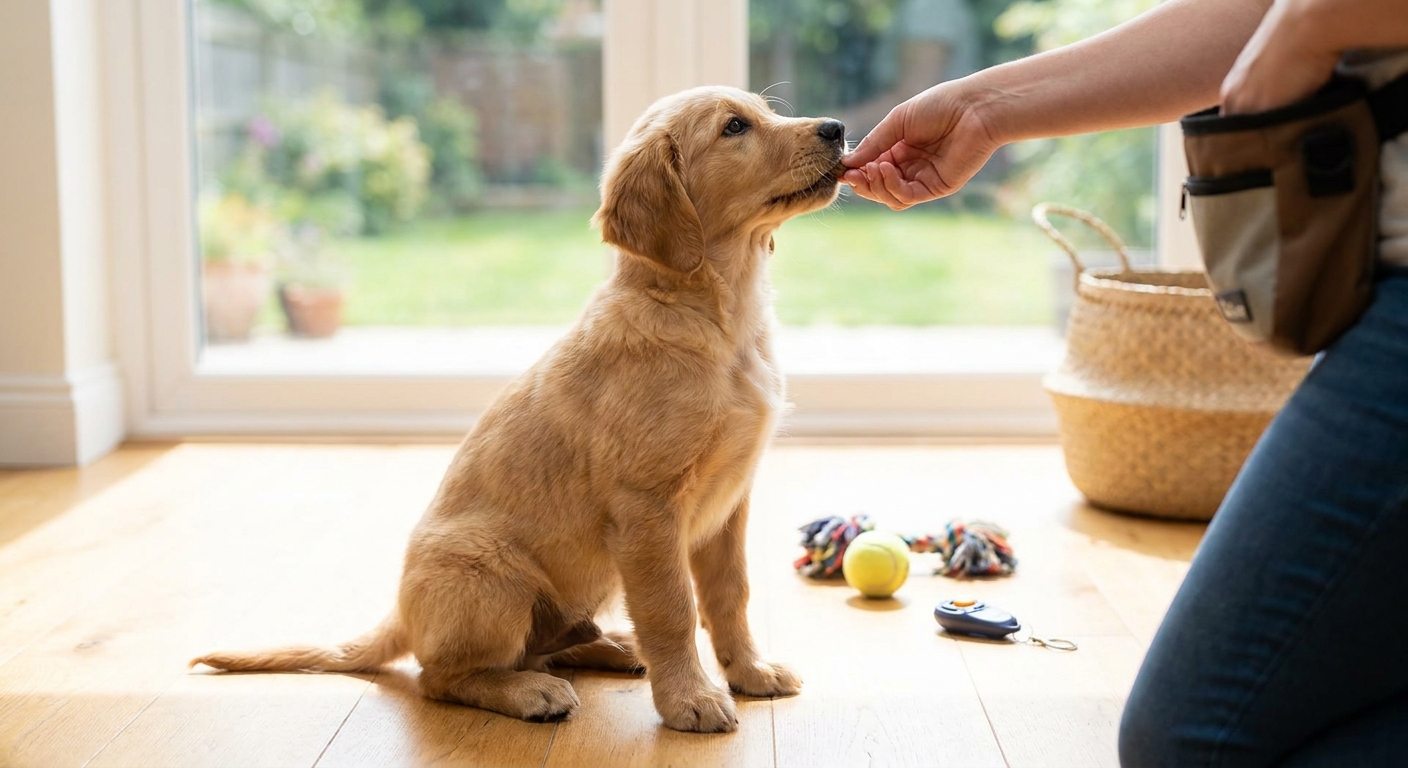
Puppies learn fastest when the reward lands within seconds of the right choice — and 2026's most-cited puppy training data still points at food, play and voice as the three levers that actually change behaviour. This guide ranks the positive reinforcement techniques that hold up in real Surrey living rooms and gardens, not just training manuals.
- Marker training (clicker or verbal ‘yes’) wins for precision timing in 2026 puppy work — buy into it early.
- Luring gets a puppy through the first fortnight but must fade by week three or it becomes a bribe habit.
- Jackpot rewards (three treats, not one) build faster recall focus than steady single treats.
- Life rewards — letting the walk continue as the payoff — beat food alone once a puppy hits 4-5 months.
- Positive reinforcement puppy training only works if the reward arrives inside 1-2 seconds of the behaviour.
Why this matters
A lot of puppy owners in Ashtead and Epsom tell me the same thing: they're rewarding their puppy constantly and nothing seems to stick. Usually the issue isn't the puppy — it's the technique. Handing over a treat five seconds after the sit, or praising in a flat voice that means nothing to the dog, teaches the puppy very little.
Positive reinforcement puppy training isn't one method. It's a toolkit, and different tools solve different problems at different ages. A 9-week-old puppy learning to sit needs luring. A 5-month-old ignoring recall in a field needs jackpots and life rewards. Mixing these up is the single biggest reason training on a loose lead walk stalls before it starts.
How this list was ranked
Each technique below is ranked on three things: how fast it produces a reliable behaviour, how well it transfers to real-world distractions (other dogs, cars, squirrels), and how often it's misused by owners with the best intentions. This isn't a lab study — it's a working list built from what actually holds up across the age range most owners are training in 2026: 8 weeks to 12 months.
The ranked techniques
1. Marker training (clicker or verbal "yes") — the precision tool
A marker is a single sound that means "that exact moment earned a reward." It closes the gap between behaviour and payoff to under half a second, which matters because a puppy's brain links reward to whatever it was doing right then, not three seconds ago.
This works for every foundation behaviour: sit, down, name recognition, settle on a mat. The mistake owners make is marking then fumbling for the treat for four or five seconds — the marker's whole job is to bridge that gap, so it still needs a treat within a couple of seconds.
Verdict: Buy. Start this in week one and keep it running through adolescence.
2. Luring — the training wheels
Luring means using a treat to guide the puppy's nose into a position — down, spin, into a crate. It gets fast results in the first two weeks because the puppy doesn't need to understand a word yet, just follow food.
The problem shows up around week three or four, when the lure hand becomes a signal the puppy waits for and won't move without. Fade the food from your hand into a hand signal by day 10-14, then reward from the other hand or a treat pot instead.
Verdict: Hold. Brilliant for the first fortnight, needs deliberate fading after that or it becomes a permanent bribe.
3. Jackpot rewards — the game changer for recall
A jackpot is three or four treats delivered one after another instead of one, given the instant a puppy does something genuinely hard — coming back from 20 metres away with a rabbit smell in the hedge, for instance. The size of the reward should match the size of the ask.
Owners who give the same single treat for every recall, easy or hard, end up with puppies who don't bother trying against real distraction. Jackpotting fixes that within days because the puppy starts betting on the bigger payout.
Verdict: Buy. Save it for the recalls and check-ins that actually cost the puppy effort.
4. Capturing — the patience play
Capturing means rewarding a behaviour the puppy offers on its own, with no cue at all — lying down calmly, checking in without being asked, sitting instead of jumping at the door. You're not asking for it, you're catching it when it happens and paying it.
This is the slowest technique on this list but arguably the most durable, because the puppy learns the behaviour is valuable in itself, not just a response to a word. It's the technique most owners skip entirely because it takes attention rather than active training time.
Verdict: Buy, especially for calm settle and polite greetings — but expect it to take longer than a scheduled training session.
5. Shaping — the puzzle piece
Shaping rewards small steps toward a bigger behaviour — a nose touch toward a target, then a paw on a mat, building up to a full "go to bed" cue. It's the technique used for anything too complex to lure or capture in one go.
Most pet owners find shaping the hardest to get right because it needs you to reward approximations, not the final behaviour, and knowing when to raise the bar takes a trained eye.
Verdict: Wait. Useful once the puppy already understands markers and basic cues — not a week-one technique.
6. Life rewards — the real-world payoff
A life reward is letting the walk continue, opening the door to the garden, or releasing to play as the reinforcement, instead of food. By 4-5 months, most puppies have had thousands of treats and start caring more about the environment than the pouch.
This is where positive reinforcement puppy training has to grow up alongside the puppy. If loose lead walking only ever gets rewarded with treats and never with "good, now you get to sniff that lamppost," the behaviour falls apart the day the treats run out.
Verdict: Buy. This is the technique that carries training past 6 months, when food alone starts losing its pull.
7. Praise and touch alone — the overused fallback
Verbal praise and a pat on the head feel positive to us, but most puppies under 12 weeks don't find them reinforcing enough to compete with a squirrel or another dog. Relying on "good boy" alone in the early months is the most common reason owners feel like nothing is sinking in.
Praise works well as a bridge alongside food or play, not as a standalone reward for anything beyond the calmest puppies in the calmest rooms.
Verdict: Skip as a sole reward before 4 months old — pair it with food or a marker instead.
Comparison table
| Technique | Best for | Effort to get right | Verdict |
|---|---|---|---|
| Marker training | Every foundation behaviour | Low once timing clicks | Buy |
| Luring | First 2 weeks, new behaviours | Low, but must be faded | Hold |
| Jackpot rewards | Recall, hard distractions | Low | Buy |
| Capturing | Calm settle, polite greetings | Medium, needs patience | Buy |
| Shaping | Complex multi-step cues | High | Wait |
| Life rewards | Loose lead, long-term reliability | Medium | Buy |
| Praise/touch alone | Bridging, not standalone reward | Low, but weak on its own | Skip |
Where to get it right
- Match the technique to the age. Luring and markers for 8-16 weeks, jackpots and life rewards from 4-5 months onward.
- Reward speed beats reward size in the first 2 seconds — a small treat delivered instantly beats a big one delivered late.
- Get outside help before bad habits set — a puppy that's already learned to ignore recall at 6 months takes longer to retrain than one caught at 12 weeks.
Get 1:1 help with your puppy’s training
Reward-based puppy programmes across Ashtead, Epsom, Leatherhead and Surrey.
FAQ
What is positive reinforcement puppy training?
Positive reinforcement puppy training means rewarding a behaviour you want repeated, usually with food, play or life rewards, delivered within 1-2 seconds of the behaviour. It’s the method most ABTC and PACT-aligned trainers use in 2026 because it builds behaviour without fear or force.
How long does positive reinforcement take to work on a puppy?
Simple behaviours like sit or name recognition can click within a single week of consistent, well-timed rewards. Reliable recall around real distraction usually takes 8-12 weeks of jackpotting and life rewards layered in.
Is clicker training better than treats alone?
A clicker or verbal marker isn’t a replacement for treats, it’s a precision tool that tells the puppy exactly which moment earned the treat. Used together they train faster than treats delivered on their own with vague timing.
Should I still reward my puppy once it knows a command?
Yes, but shift from a treat every time to life rewards and occasional jackpots once the behaviour is reliable. Dropping all reinforcement too early is the most common reason a trained behaviour fades by 6-8 months.
What treats work best for puppy training?
High-value, soft, pea-sized treats work best because they’re eaten fast enough to keep training moving. Save the highest-value option for jackpots and hard recalls, not routine sits at home.
Can positive reinforcement fix jumping up?
Yes — capturing four paws on the floor and life-rewarding it with attention works better than punishing the jump, because it teaches the puppy what to do instead of just what not to do.
Does positive reinforcement work for loose lead walking?
It does, but it needs life rewards layered on top of treats once the puppy is past the food-motivated stage, usually around 4-5 months. Treat-only loose lead training tends to break down the moment the treats stop.
Is it too late to switch to positive reinforcement with an older puppy?
No — a 6-8 month old puppy can still learn through marker training and jackpots, it just takes more repetitions than it would have at 10 weeks. The techniques don’t change, the timeline does.
One last thing
The technique that gets skipped most often isn't the exotic one — it's capturing calm. Owners spend weeks running structured sessions for sit and recall and never once reward the puppy for lying down quietly by the sofa, so the puppy never learns that calm pays too. Start rewarding stillness this week and most of the "hyper puppy" complaints I hear in Surrey start easing within days, not months.
Related guides

