
If you've just brought home a rescue dog who flinches at sudden movement or won't take a treat from your hand, generic puppy classes and Instagram dog training won't cut it — this guide covers what nervous rescue dogs actually need and how to tell a good approach from a wasted one.
- Dog training for rescue dogs works best when it starts with a decompression period, not obedience drills, in the first 2-3 weeks home.
- 1:1 sessions beat group classes for nervous rescues because there’s no pressure to perform in front of strangers or other dogs.
- Force-free, reward-based methods are non-negotiable for fearful dogs — correction-based training raises stress hormones and slows trust-building.
- Recall and loose lead walking should wait until the dog is eating normally and sleeping through the night, usually 3-6 weeks in.
- Proud Dog runs 1:1 rescue dog training and behaviour support across Ashtead, Epsom, Leatherhead, Cobham, Oxshott and Dorking — start there, not with a group class.
Why this matters
A nervous rescue dog isn't being difficult — their nervous system is doing exactly what it evolved to do after months or years of instability. Pushing recall training or trying to socialise them at the park in week one usually backfires, because a dog running on adrenaline can't learn new associations the way a calm dog can.
The mistake most owners make in 2026 is treating a rescue dog like a blank-slate puppy. It isn't. It's an adult (or adolescent) animal with a history you don't know, and dog training for rescue dogs has to account for that history even when you can't see it.
Who this is for
This is written for owners in Surrey and the surrounding areas who've adopted a dog in the last few weeks or months and are seeing fear-based behaviour — hiding, freezing on walks, snapping when startled, refusing food, or bolting at the front door. It's not for owners of confident rescues who just need basic manners; that's a different, much simpler job.
Proud Dog works with exactly this profile of dog across Ashtead, Epsom, Leatherhead, Cobham, Oxshott and Dorking, and the pattern is consistent: the dogs that come on fastest are the ones whose owners slow down first.
What to look for in dog training for nervous rescue dogs
Force-free, reward-based methods only
A fearful dog needs to learn that hands and humans predict good things, not consequences. Any trainer still using check chains, prong collars or "dominance" language in 2026 is working against the exact trust you're trying to build, and the science on stress hormones in corrected dogs backs this up.
1:1 sessions, not group classes
Group classes put a nervous dog in a room full of strangers, other dogs, and noise — the opposite of what a decompressing rescue needs. One-to-one sessions let the pace match the dog in front of you instead of the slowest or fastest dog in a group of eight.
A decompression-first plan
Any programme that jumps straight to recall or loose lead walking in session one is skipping a step. The first sessions should focus on settling behaviours, safe handling, and building a food or toy reward that actually motivates a stressed dog.
Home-based or low-stimulus locations
Where the training happens matters as much as what's taught. A nervous rescue dog learns faster in their own garden or a quiet Surrey lane than in a busy training hall, especially in the first 4-6 weeks.
Realistic timelines, not quick fixes
Anyone promising a "calm dog in one session" isn't being straight with you. Genuine behaviour change in a nervous rescue dog is measured in weeks and months, not days.
Qualifications you can actually check
Look for trainers registered with bodies like ABTC or PACT rather than trainers who self-describe as "behaviourists" with no accreditation. This matters more with rescue dogs than with puppies, because fear-based cases sit closer to behaviour work than basic obedience.
What actually works for nervous rescue dogs
The foundation pick — decompression before anything else. No walks, no visitors, no dog park for the first 2-3 days minimum, sometimes up to 2 weeks for dogs with a harder history. Buy into this even though it feels like doing nothing — it's the single biggest predictor of how the rest of training goes.
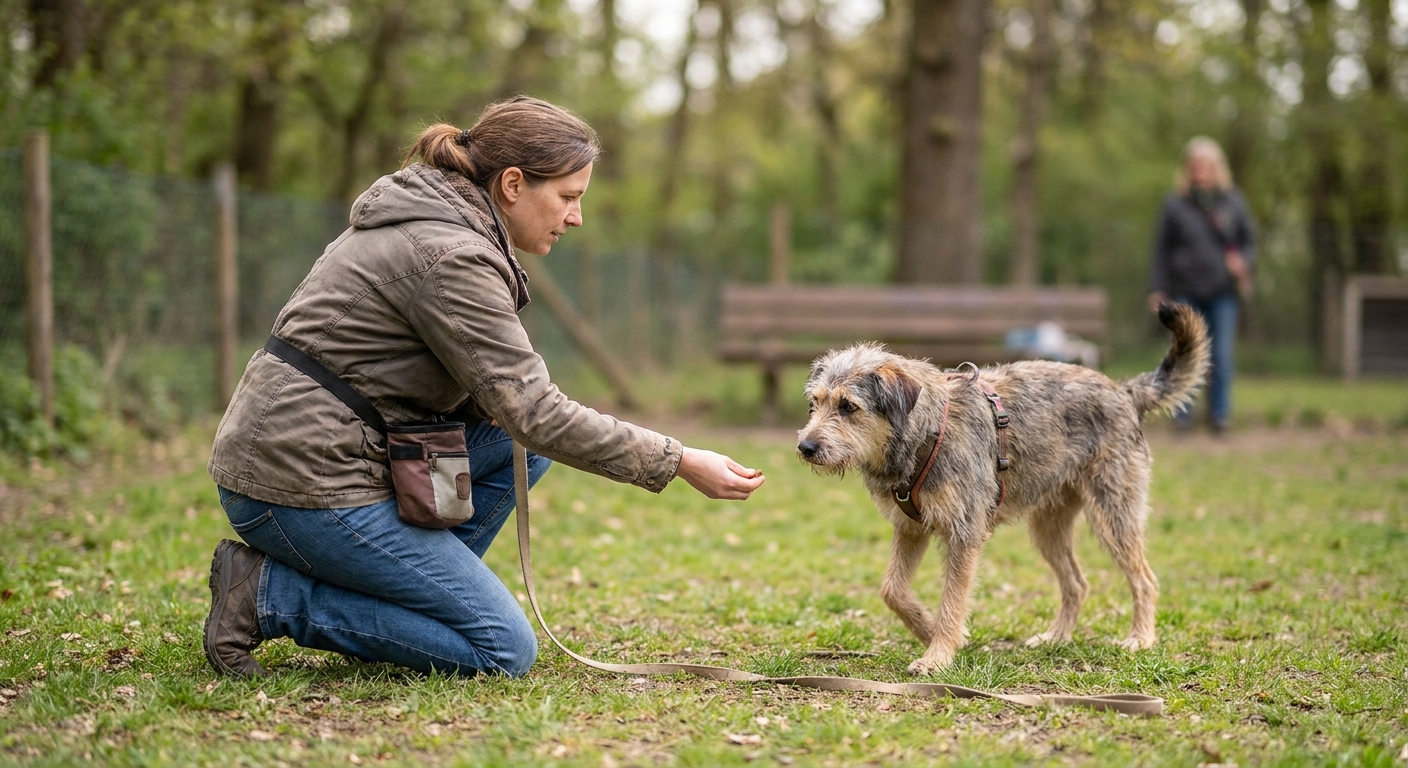
The trust-builder — hand-feeding and choice-based interaction. Letting the dog approach you rather than the other way round, using every meal as a training opportunity. Owners typically see the first tail wag or relaxed body language within 7-10 days of consistent hand-feeding. Buy.
The structured option — 1:1 in-home sessions with a qualified trainer. This is where Proud Dog sits: reward-based dog training and behaviour support delivered at your own pace, in your own home or local area, rather than a fixed group timetable. For a genuinely nervous rescue, this is usually the fastest route to a workable routine. Buy.
The wildcard — scentwork and enrichment games. Sniffing lowers a dog's heart rate more reliably than a walk does, and it gives a fearful dog a job that doesn't require confidence around people or other dogs. Low cost, low risk. Consider.
The overreach — early off-lead recall training. Trying to build reliable recall before the dog trusts you at all sets both of you up to fail, and a bolted dog in an unfamiliar Surrey town is a genuinely dangerous outcome. Wait until loose lead walking is solid on a long line first.
What to avoid
- Flooding: forcing exposure to crowds, other dogs or busy high streets to "get it over with" — this deepens fear rather than resolving it.
- Correction-based trainers who use rescue-friendly language: some still market themselves as gentle while using aversive tools once you're in the room. Ask directly what equipment and methods they use before booking.
- Comparing your rescue to a puppy timeline: a rescue dog's setbacks (a growl, a refusal to walk, a bad night) aren't regression — they're normal, and panicking about them slows progress more than the setback itself.
Comparison at a glance
| Criteria | Why it matters for nervous rescues | Red flag to watch for |
|---|---|---|
| Method | Reward-based builds trust; corrections raise fear | Trainer mentions dominance, pack leader, or "balanced" tools |
| Session format | 1:1 matches the dog's pace, not the group's | Fixed group class as the only option offered |
| Starting point | Decompression before commands | Recall or lead work pushed in week one |
| Location | Home or low-stimulus first | Busy hall or park insisted on from day one |
| Timeline | Weeks to months, honestly stated | "Fixed in one session" claims |
| Credentials | ABTC, PACT or equivalent | No verifiable accreditation |
Get 1:1 support for your rescue dog
Reward-based training and behaviour support across Surrey, built around your dog’s pace.
FAQ
What’s the best dog training for rescue dogs with severe fear?
Force-free, 1:1 training that starts with decompression rather than commands works best for severely fearful rescue dogs. Group classes and correction-based methods tend to increase stress and slow progress in 2026 as much as they did a decade ago.
How long does it take to train a nervous rescue dog?
Most nervous rescue dogs show real settling within 3 weeks and feel genuinely at home by 3 months, following the widely used ‘3-3-3 rule’. Deeper behaviour issues like reactivity can take several months of consistent 1:1 work.
Should I take a nervous rescue dog straight to puppy classes?
No — group puppy classes are usually the wrong first step for a fearful adult rescue. The noise, other dogs and pressure to perform can undo weeks of trust-building at home.
Is 1:1 dog training better than group classes for rescue dogs?
For nervous rescue dogs, yes. One-to-one sessions let the trainer match the pace to the dog in front of them instead of the average pace of a group.
How much does dog training for rescue dogs cost?
Costs vary by trainer, location and number of sessions needed, so check current pricing directly with a qualified 1:1 trainer in your area. Behaviour work for fearful rescues typically needs more sessions than basic puppy training.
Can a nervous rescue dog ever be fully confident?
Many nervous rescue dogs reach a genuinely settled, confident state, though the timeline depends on their history and how consistent the training is. Some dogs keep specific triggers (like men in hats or loud vehicles) even after months of solid progress.
What should I avoid doing with a newly adopted rescue dog?
Avoid flooding the dog with visitors, walks and new environments in the first days home. A quiet, predictable routine does more for a nervous rescue than any single training exercise.
Do rescue dogs need a different approach to loose lead walking?
Yes — loose lead walking should wait until the dog is eating and resting normally, often several weeks after adoption. Starting too early on a dog that’s still in fight-or-flight mode usually results in pulling, freezing or bolting.
One last thing
The dogs that regress hardest aren't the ones with the worst histories — they're the ones whose owners tried to fix everything in the first month. A rescue dog who's allowed to do nothing for two weeks almost always trains faster in month two than one who was walked, socialised and drilled from day one.

