
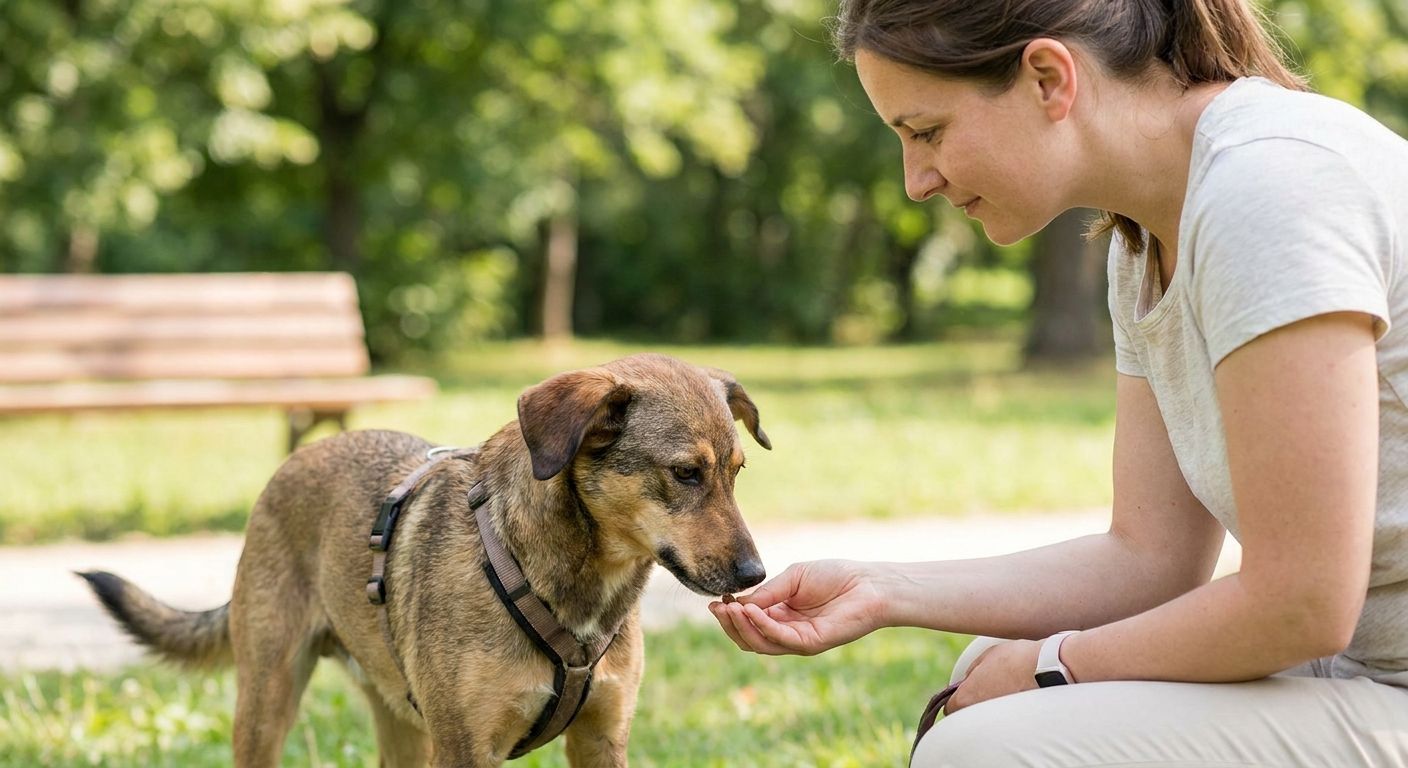
Anxious dogs don't need more corrections — they need a training approach that lowers their stress while building new habits, and reward-based dog training for anxious dogs is the only method backed by current canine behaviour science that does both at once in 2026.
- Desensitisation and counter-conditioning is the strongest reward-based dog training method for anxious dogs in 2026 – use it first.
- Pattern games and the engage-disengage game give fast wins for leash reactivity and street anxiety.
- Flooding and dominance-based corrections make anxiety worse – skip them regardless of how quick they look.
- Decompression walks support the training but don’t replace it – hold them as a companion tool, not a fix.
- Proud Dog builds these methods into 1:1 sessions across Surrey rather than group classes, which suits most anxious dogs better.
Why this matters
An anxious dog isn't being stubborn or dominant – its nervous system is stuck in a stress loop, and punishment-based corrections add cortisol to a dog that's already flooded with it. Reward-based methods work because they change the dog's emotional response to the trigger first, then layer a new behaviour on top of that calmer state.
This matters practically because owners searching for anxious dog training in 2026 are often already exhausted – they've tried the shouting, the choke lead, the "just be firmer" advice from a well-meaning relative, and the dog has got worse, not better. The methods below are ranked by how reliably they shift that emotional baseline, not by how flashy they look on video.
Getting proper support early matters more than most owners realise. You can read more about Proud Dog and how 1:1 sessions across Ashtead, Epsom, Leatherhead, Cobham, Oxshott and Dorking are structured around this exact problem.
How this list is ranked
Each method below is ranked against three things: how consistent the evidence is across canine behaviour literature, how fast an anxious dog typically shows a change in body language, and how easy the method is for an average owner to run correctly at home without a professional in the room every time.
Methods rooted in desensitisation, counter-conditioning and differential reinforcement sit at the top because they're the foundation the ABTC and most PACT-registered trainers build behaviour plans around. Methods that rely on flooding, physical correction or forced exposure sit at the bottom, not because they're untested, but because the evidence on anxious dogs specifically shows they suppress the visible signal (the growl, the freeze) without resolving the underlying stress – which is a welfare problem, not a training win.
The ranked list
1. Desensitisation and counter-conditioning
The slow-and-steady method that actually rewires the dog's opinion of the trigger. You expose the dog to a watered-down version of whatever scares it – a doorbell at low volume, a stranger at 20 metres – and pair it with something genuinely good, usually food, before gradually closing the distance.
This is the method every credible anxious-dog protocol is built on in 2026, and it's the reason a dog that used to bolt at the postman can eventually sit calmly while the letterbox goes. The catch is patience: rushing the distance or volume undoes weeks of work in one bad rep.
Verdict: Buy – this is the base layer for every anxious dog case, full stop.
2. Pattern games (1-2-3 game, Look at That)
Simple, repeatable games that give an anxious dog a predictable script to follow instead of a decision to make. The 1-2-3 game (walk three steps, treat, repeat) turns a stressful walk into a rhythm the dog can lean on.
What makes pattern games so useful for anxious dogs specifically is that they remove the need for the dog to choose between "fight, flight or freeze" – the pattern does the choosing for them. Owners see a visible change in loose lead walking and pulling within two to three sessions in most cases.
Verdict: Buy – especially strong for street anxiety and reactive lead walking, which pairs well with a structured loose lead walking approach.
3. Engage-disengage game
A specific protocol where the dog is rewarded for noticing a trigger and then voluntarily looking back at you, rather than being asked to ignore the trigger outright. It's one of the most-cited tools for reactive and anxious dogs because it doesn't ask for something the dog can't yet do.
The mechanism matters here: you're not suppressing the look, you're rewarding the choice to disengage from it. That distinction is what makes the change stick rather than just masking the symptom.
Verdict: Buy – one of the fastest wins for dogs that react to other dogs or people on walks.
4. Capturing calm behaviour (mat work)
You reward the dog for choosing to settle – lying on a mat, sighing, releasing muscle tension – rather than for performing a cue. Over time the mat itself becomes a cue for calm, which is genuinely useful in a busy household or a waiting room.
For anxious dogs this works because it teaches an alternative default state instead of just interrupting the anxious one. It's slower to build than pattern games but the payoff is a dog that can self-settle without you managing every second.
Verdict: Buy – low effort, high payoff, particularly good for dogs anxious around visitors or noise.
5. Decompression walks and sniffing time
Long-line walks in low-stimulus environments where the dog is free to sniff, wander and process at its own pace, with no cues, no heel position, no demands. Sniffing lowers heart rate and gives an anxious dog a job that isn't about managing a threat.
This isn't a training method on its own – it's a support tool that keeps the dog's baseline stress low enough for the actual training to land. Skipping it and going straight into structured sessions with a chronically stressed dog tends to produce slower progress.
Verdict: Hold – essential alongside the other methods, not a replacement for them.
6. Differential reinforcement of alternative behaviour (DRA)
You reward a specific behaviour that's incompatible with the anxious response – sitting instead of lunging, for example. It's precise and it works well once a dog already has some foundation cues in place, which is why it sits mid-table rather than at the top: dogs with no prior training struggle with the demand before the emotional work is done.
Verdict: Hold – powerful as a second-stage method, not a starting point for a dog with no groundwork.
7. Flooding and forced exposure
Throwing the dog into the full-strength version of what scares it – a crowded event, a room full of strangers – on the theory that it'll "get over it." Some dogs go quiet under this. That quiet is very often shutdown, not confidence, and it's a well-documented welfare red flag in 2026 behaviour guidance.
Verdict: Skip – the fastest way to make an anxious dog worse and harder to help later.
8. Dominance-based corrections (alpha rolls, forced eye contact, choke corrections)
Still floating around in outdated advice columns and some older training books, this approach assumes anxiety is a status problem. It isn't. Applying physical or confrontational corrections to a dog that's already anxious adds fear on top of fear and frequently escalates to defensive aggression.
Verdict: Skip – not supported by current behaviour science and actively risky with anxious dogs.
Comparison table
| Method | Best for | Time to see change | Effort level | Verdict |
|---|---|---|---|---|
| Desensitisation & counter-conditioning | Specific triggers (noise, strangers) | Weeks | Medium-high | Buy |
| Pattern games | Reactive walks, lead pulling | Days | Low | Buy |
| Engage-disengage game | Reactivity to dogs/people | Days-weeks | Low-medium | Buy |
| Capturing calm (mat work) | Visitors, household stress | Weeks | Low | Buy |
| Decompression walks | Ongoing stress baseline | Ongoing | Low | Hold |
| DRA | Dogs with existing cues | Weeks | Medium | Hold |
| Flooding | Nothing an anxious dog needs | N/A | N/A | Skip |
| Dominance corrections | Nothing an anxious dog needs | N/A | N/A | Skip |
Where to get proper support
- Look for ABTC-accredited or PACT-registered trainers – these bodies require reward-based, LIMA-first methods as a condition of membership, not a marketing line.
- Avoid anyone who suggests a prong collar, e-collar or "pack leader" correction for an anxious dog – that's a sign the trainer isn't working from current behaviour science.
- Start with a 1:1 assessment rather than a group class – a group setting is often the worst possible environment for a dog that's already anxious around other dogs or people.
Get a plan built around your dog
1:1 reward-based sessions across Ashtead, Epsom, Leatherhead, Cobham, Oxshott and Dorking.
FAQ
What is the best reward-based training method for anxious dogs?
Desensitisation and counter-conditioning is the strongest method in 2026 because it changes the dog’s emotional response to the trigger, not just the surface behaviour. Pattern games and the engage-disengage game are strong second-line tools for reactive walks.
Is reward-based training better than corrective training for anxious dogs?
Yes – corrective methods add stress to a nervous system that’s already overloaded, which tends to worsen anxiety rather than resolve it. Reward-based methods lower stress first, which is why ABTC and PACT-registered trainers use them as standard.
How long does it take to see progress with an anxious dog?
Pattern games can show visible change within days, while desensitisation to a specific trigger usually takes several weeks of consistent short sessions. Progress isn’t linear – expect some sessions to look like no change at all before a jump forward.
Can I train an anxious dog myself or do I need a professional?
Simple tools like pattern games and mat work are manageable at home, but a 1:1 assessment from an ABTC-accredited trainer catches mistakes in timing and distance that owners often miss. This matters more for reactive or fear-based anxiety than for general nervousness.
Does flooding work faster than reward-based training?
Flooding can produce a quiet dog quickly, but that quiet is frequently shutdown rather than genuine calm, and it’s a recognised welfare risk in current behaviour guidance. It should be avoided with anxious dogs regardless of the apparent speed.
What’s the difference between desensitisation and counter-conditioning?
Desensitisation is gradually reducing the intensity of a trigger so the dog can cope with it; counter-conditioning is pairing that trigger with something the dog loves, like food. In practice the two are almost always run together, which is why they’re listed as one method.
Are decompression walks a replacement for training?
No – decompression walks lower the dog’s baseline stress so training actually sticks, but they don’t teach new behaviours on their own. Think of them as the foundation the other methods are built on top of.
Is group class training suitable for an anxious dog?
Usually not as a first step – a room full of unfamiliar dogs and people is often the exact trigger an anxious dog struggles with most. A 1:1 assessment lets the plan start at a distance and pace the dog can actually manage.
One last thing
The method that gets the least credit is decompression walking, and it's often the reason a well-designed training plan stalls anyway – a dog running on a chronically raised stress baseline can't learn new associations no matter how good the counter-conditioning is. Fix the baseline first in 2026, and the reward-based work above will move faster than most owners expect.

