
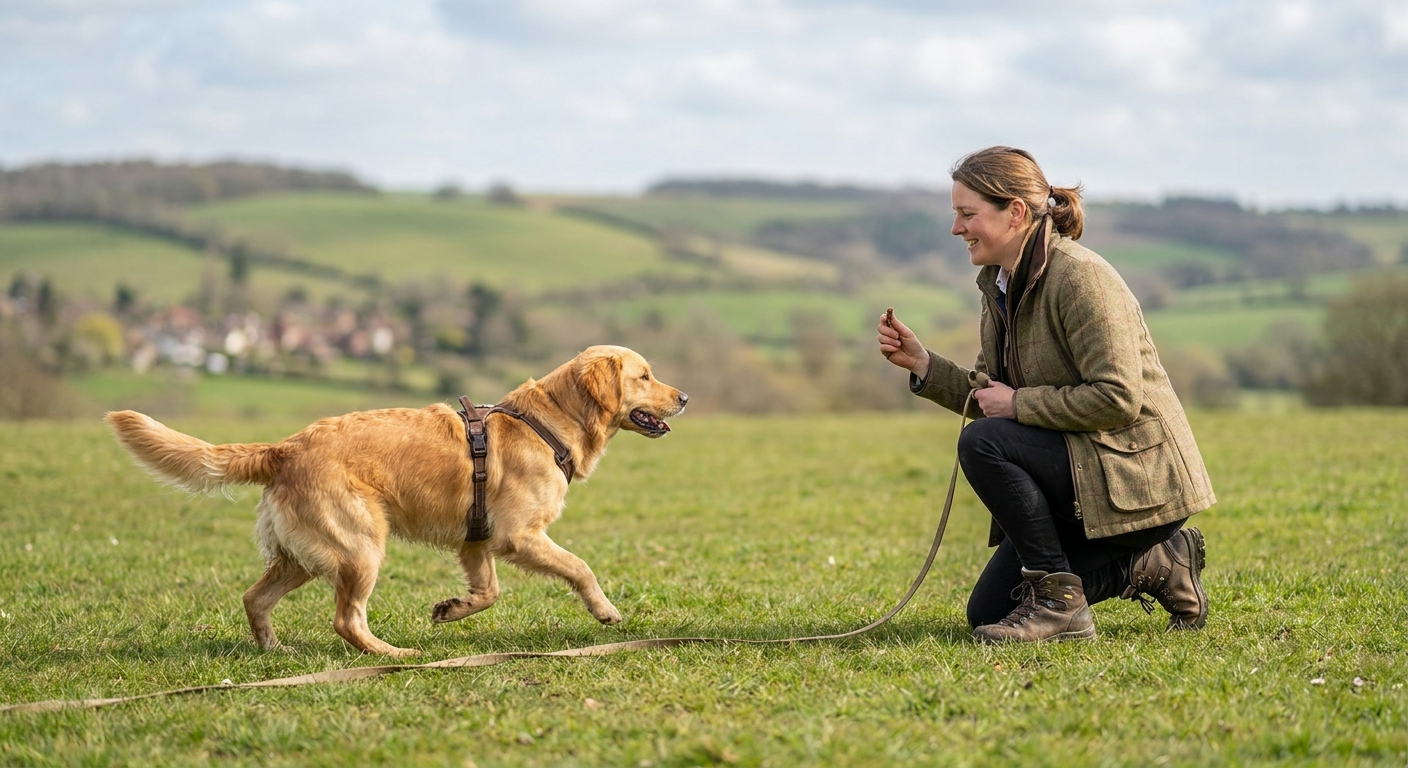
Recall that actually works on Epsom Common, in the woods above Leatherhead, or on the muddy paths near Bookham — not just in your quiet back garden — is what most Surrey owners are missing, and it's fixable with the right approach.
- Recall training surrey needs real distraction proofing on commons and woodland, not just garden practice.
- 1:1 reward-based sessions with Proud Dog are the safe pick for reliable off-lead recall in 2026.
- Group classes work for confident, social dogs but are a skip for reactive or nervous ones.
- Long-line practice alone rarely gets you to full off-lead reliability without structured sessions.
- Avoid dominance-based recall methods — they damage trust and slow progress in adolescent dogs.
Why this matters
Surrey isn't a flat suburban grid. You've got open commons in Epsom, deer-heavy woodland around Ashtead and Leatherhead, water at Cobham and Oxshott, and livestock fields near Dorking. Every one of those environments throws a different distraction at your dog, and generic recall advice from a book or a YouTube video doesn't account for any of it.
Proud Dog builds recall training around the actual places you walk, not a theoretical park. That's the difference between a dog who comes back when called and a dog who comes back when called unless there's a squirrel, a jogger, or another dog within 50 metres.
Who this is for
This guide is for Surrey dog owners whose dog's recall falls apart the moment something interesting shows up — the ones standing in a field shouting a name that's being completely ignored. It's for puppy owners in Ashtead or Oxshott who want to get ahead of the problem before adolescence hits, and for owners of adolescent or rescue dogs in Epsom, Leatherhead, Cobham or Dorking who've tried treats-in-the-garden training and hit a wall the second real-world distractions enter the picture.
What to look for in recall training for Surrey dog owners
Real distraction proofing, not garden-only drills
A recall that only works in your kitchen or garden isn't recall — it's a party trick. Surrey's commons, woodland and open farmland mean your dog needs proofing against deer, livestock, joggers and off-lead dogs, and that only happens by training in those actual environments, gradually and on a long line before you ever drop it.
Reward-based methods over corrections
Recall built on fear of punishment collapses the moment the dog decides the chase is worth the risk. Reward-based recall training builds a dog that wants to come back because coming back has always paid off — treats, toys, praise, whatever your dog genuinely values — and that motivation holds up even with a rabbit bolting across the path.
A trainer with recognised qualifications
Anyone can call themselves a dog trainer with zero oversight. Look for ABTC registration or PACT membership, because these bodies require ongoing assessment against welfare-focused, science-based standards, not just a weekend certificate.
Training locations that match where you actually walk
If every session happens in a fenced garden, the skills won't transfer to Bookham Common or the woods above Dorking. Ask whether sessions move to real off-lead environments as your dog's recall improves, with distance and distraction increased in stages.
Flexibility for nervous or reactive dogs
A dog who's worried about other dogs or people needs a different recall plan than a confident, social Labrador. One-size-fits-all group formats often make reactive dogs worse, not better, so ask how the programme adapts when your dog isn't the easy case.
Follow-up support after the initial sessions
Recall regresses if it isn't maintained through adolescence, roughly 6 to 18 months, when many dogs go through a genuine flight-instinct phase and start testing boundaries they'd previously respected. A trainer who checks in after the main block of sessions is worth more than one who disappears once the invoice is paid.
Top picks for recall training in Surrey
1:1 in-person recall sessions — the safe pick
One-to-one sessions let a trainer build a plan around your specific dog, your specific walking spots, and your specific problem, whether that's a Cobham cocker spaniel who bolts for water or a Dorking terrier who's decided livestock fields are more interesting than you are. Sessions typically progress from garden and quiet street work up to full off-lead proofing on commons and woodland over a matter of weeks, not a single afternoon.
Verdict: Buy. This is the most reliable route to genuine off-lead recall for Surrey's mixed terrain in 2026, because the training environment matches the real environment.
Group recall classes — the wildcard
Group settings add controlled distraction from other dogs and people, which is genuinely useful for confident, social dogs who need practice ignoring lower-level temptations. The wildcard part is that quality varies hugely between providers, and a poorly run group class can undo weeks of 1:1 progress if a reactive dog gets overwhelmed.
Verdict: Consider — only for dogs who are already comfortable around other dogs, and only as a supplement to individual work, not a replacement for it.
DIY long-line practice — the budget option
A 5 to 10 metre long line lets you practice recall safely in open spaces without risking your dog bolting into a road or a field of sheep. It costs almost nothing beyond the line itself and it's a genuinely useful daily habit once the foundations are in place.
Verdict: Consider as a maintenance tool alongside structured training, but Skip it as your only method — without a trainer's eye on your technique, most owners repeat small mistakes (poor timing, unclear cues, rewarding too late) that quietly cap how far the dog's recall ever gets.
Board-and-train recall camps — proceed with caution
Handing your dog over for an intensive recall "camp" promises fast results, but recall built entirely by someone else doesn't automatically transfer to you as the handler. The dog learns to respond to a stranger's cues in a strange environment, and you're left trying to replicate a relationship you weren't part of building.
Verdict: Skip for most Surrey owners in 2026 — the time saved upfront is usually paid back in confusion and inconsistent results once the dog comes home.
Book a recall assessment
1:1 sessions built around your dog and your Surrey walking spots.
What to avoid
- Shock collars and dominance-based "corrections" — they suppress the behaviour you see without fixing the motivation underneath, and they can make a nervous dog more unpredictable around the exact distractions you're trying to train against.
- One-off group workshops sold as a complete fix — a single two-hour session can't proof a dog against the range of distractions Surrey's commons and woodland throw up across different seasons and times of day.
- Off-lead drops before long-line proofing is solid — dropping the line early because recall "seems good" in low-distraction settings is the single most common reason recall training stalls around livestock fields near Dorking or busy paths in Epsom.
Recall training options compared
| Option | Distraction proofing | Suited to reactive dogs | Trainer feedback | Verdict |
|---|---|---|---|---|
| 1:1 sessions | Strong, real environments | Yes | Direct, ongoing | Buy |
| Group classes | Moderate | No | Limited, shared | Consider |
| DIY long-line | Weak without guidance | Depends on owner | None | Consider |
| Board-and-train camp | Strong but not transferred | Variable | Minimal after handover | Skip |
FAQ
What’s the best recall training in Surrey for a nervous or reactive dog?
1:1 sessions are the best fit for nervous or reactive dogs because the pace and environment adapt to that individual dog, unlike group classes. A trainer can start recall work away from triggers and slowly introduce distraction as confidence builds.
Is recall training surrey different from generic recall advice online?
Yes, because Surrey’s commons, woodland and livestock fields create distractions that generic garden-based advice doesn’t prepare a dog for. Training that happens in real local environments like Epsom Common or the woods above Ashtead transfers far better to daily walks.
How long does it take to fix poor recall in an adolescent dog?
Most adolescent dogs, roughly 6 to 18 months old, show noticeable improvement within a few weeks of consistent 1:1 sessions, though full off-lead reliability around strong distractions can take longer. Adolescence brings a genuine flight-instinct phase, so patience through this stage matters as much as technique.
Can group recall classes work instead of 1:1 sessions?
Group classes work well as a supplement for confident, social dogs but rarely replace 1:1 work for dogs with an existing recall problem. A dog who already bolts for distractions needs individual attention before a group setting adds more of them.
Do I need a long line for recall training in 2026?
A 5 to 10 metre long line is one of the most useful tools for safe recall practice in open spaces, and most trainers recommend it throughout the proofing stages. It lets you practice near real distractions without risking a bolt onto a road or into livestock.
Should I use a shock collar to fix bad recall?
No, shock collars and other correction-based tools tend to suppress visible behaviour without fixing what’s driving it, and they can increase anxiety around the very triggers you’re training against. Reward-based methods build recall that holds up because the dog wants to return, not because it’s afraid not to.
What qualifications should a Surrey dog trainer have?
Look for ABTC registration or PACT membership, since both require trainers to meet assessed, welfare-focused standards rather than a one-off weekend course. This matters most with recall work, where poor technique can damage trust rather than build it.
How much does 1:1 recall training cost in Surrey?
Costs vary by trainer and by how many sessions your dog needs, so it’s worth checking current pricing directly with a local provider. Dogs with more established recall problems generally need more sessions than puppies starting fresh.
One last thing
Most owners drop the long line the moment recall looks solid in a quiet field, then wonder why it falls apart the first time a deer crosses the path near Ashtead. The line isn't a crutch — it's the bridge between garden-perfect recall and the real, distraction-heavy Surrey countryside your dog actually lives in, and keeping it on longer than feels necessary in 2026 is usually the fastest route to genuine off-lead reliability.

