
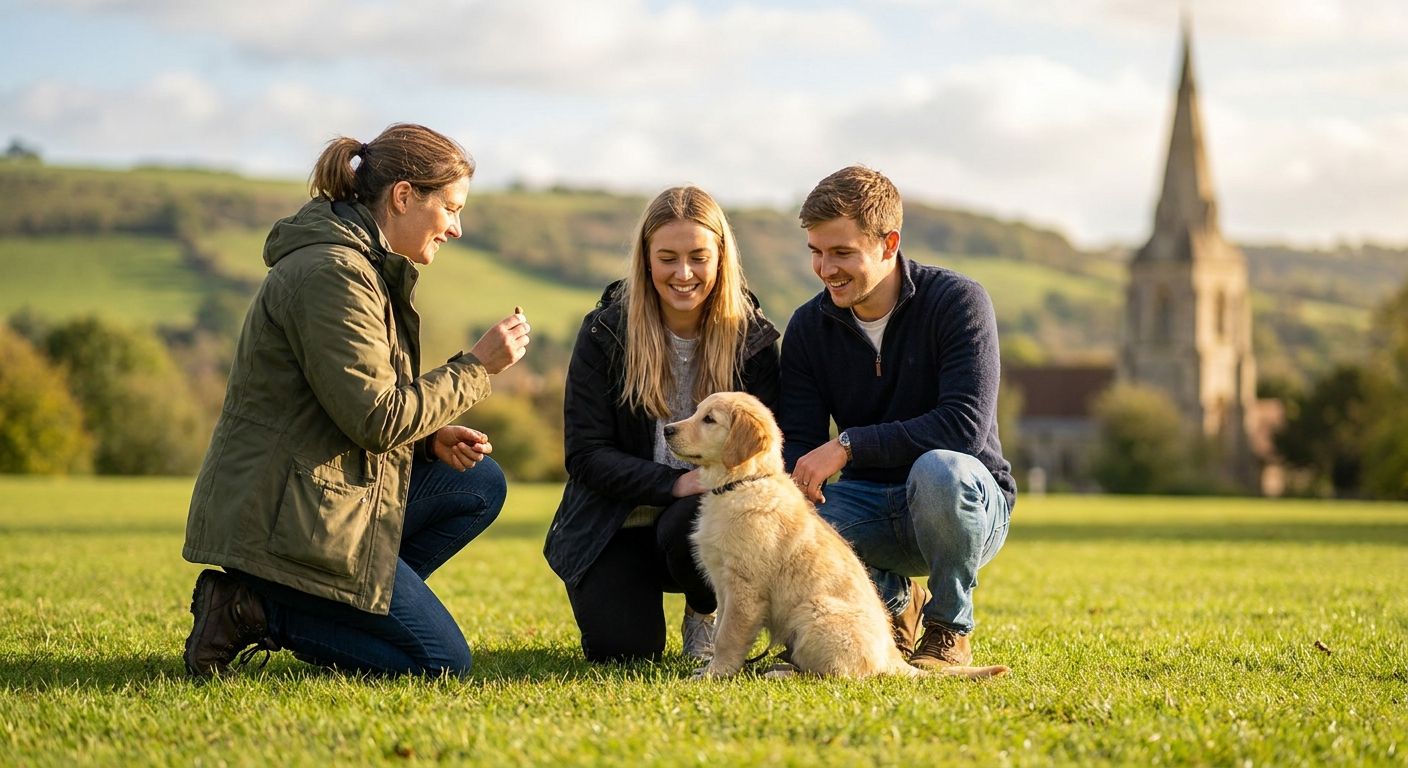
If you've just brought a puppy home in Dorking, Ashtead, Leatherhead or one of the villages around them, this guide covers what actually matters when choosing puppy training in 2026 — not the generic checklist, but the questions a Surrey family with a normal, busy life should be asking.
- 1:1 puppy training in Dorking beats group classes for recall and reactive behaviours in 2026 — book home-based sessions.
- Reward-based methods with ABTC or PACT qualified trainers are the only credible standard this year.
- The socialisation window closes around 16 weeks, so start puppy training before six months, not after.
- Loose lead walking needs dedicated practice separate from general obedience work — Skip programmes that lump it in with basic sit-stay.
Why this matters
A lot of puppy training advice online is written for nobody in particular. Dorking families are dealing with the North Downs, dog-friendly pubs on the high street, school runs, and a puppy who needs to cope with all of it by six months old, not just sit nicely in a kitchen.
Get the early months wrong and you're often still fixing jumping up, pulling, or a puppy that won't come back off lead a year later. Get them right and 2026 becomes the year your dog actually fits your life instead of running it.
Who this is for
This is for Surrey families — in Dorking, Epsom, Cobham, Oxshott, Ashtead and Leatherhead — with a puppy under twelve months who wants practical, reward-based training that works in real settings: the garden, the school run, the pub garden, the woods. It's not for owners looking for show-ring precision or quick-fix obedience tricks.
What to look for in puppy training for Dorking families
Reward-based methods, not dominance language
Any trainer still talking about "pack leadership" or correction collars in 2026 is behind the evidence. Reward-based training builds a puppy that wants to work with you rather than one that's simply suppressed. For families with kids around the house, that difference matters every single day, not just in a training session.
Recall that works off lead in real countryside
Dorking sits right against the North Downs, so recall isn't a nice-to-have — it's the difference between a relaxed walk and a stressful one. Look for a programme that practices recall around actual distractions: other dogs, joggers, livestock fields, not just an empty hallway.
Dedicated loose lead walking work
Pulling on lead is one of the most common complaints from new puppy owners, and it rarely fixes itself. It needs its own structured practice, not five minutes tacked onto a sit-stay session. How to train your dog to walk on a loose lead breaks down the mechanics if you want to see what proper lead work actually involves.
Socialisation in local, real-world settings
A puppy that's only ever met other dogs at a training hall hasn't been socialised for Dorking life — the farmers market, the school gates, the dog-friendly cafés. Good training gets your puppy comfortable in the actual places you'll be taking them.
Flexibility around family schedules
Home visits that fit around school pickups, work-from-home days or shift patterns matter more than a fixed Tuesday evening class slot. Ask whether sessions can happen in your own home and garden, where most of the real problems (jumping up at the door, door-dashing) actually live.
Qualifications that back up the claims
Look for ABTC or PACT accreditation rather than a certificate from a weekend course. Those bodies set a standard for reward-based, ethical training that a lot of self-taught "trainers" simply don't meet in 2026.
Types of puppy training support to consider
1:1 home-based training — the safe pick. Sessions happen where the problems actually happen: your hallway, your garden, your street. One concrete number worth knowing — most puppies need consistent daily practice of 5-10 minutes, several times a day, rather than one long weekly session, and a home-based trainer can show you exactly how that fits your routine. Buy if you want results that transfer to real life, not just a training hall.
Group puppy classes — the social pick. Good for basic manners and controlled exposure to other puppies, but harder to tailor to a specific issue like door-dashing or a Taz-in-the-kitchen puppy at 6pm. Consider as a supplement to 1:1 work, not a replacement for it.
Online-only puppy courses — the budget pick. Fine for background theory, but nobody watching a video can see that your puppy is actually terrified of the postman, not just "a bit barky". Consider only alongside in-person support, never on its own.
DIY training from books and forums — the wildcard. Some owners do get results this way, but there's no one there to catch the small mistakes — poor timing on rewards, inconsistent cues — that turn into six-month-old habits. Skip if your puppy already has a specific behaviour worry like jumping up or recall.
Board-and-train residential programmes — the shortcut that isn't. The puppy learns to behave for the trainer, not for you, and the transfer back to your household routine often falls apart within days. Skip for families who want a puppy that listens to them, not a stranger.
Get 1:1 puppy training in Dorking
Home-based, reward-based sessions built around your family’s routine.
What to avoid
- Trainers who guarantee a "fixed" dog in a set number of sessions. Every puppy learns at a different pace, and a fixed promise is usually a sales line, not a training plan.
- Group-only programmes with no home visit option. If nobody sees your actual doorway, your actual garden, your actual dog-walking route, they're training a version of your puppy that doesn't quite exist.
- Anything using shock collars, spray collars or "correction" tools. These are increasingly rare among qualified trainers in 2026 for good reason — they suppress behaviour rather than teach an alternative.
Verdict comparison
| Approach | Reward-based | Works in real Dorking settings | Fits family schedule | Verdict |
|---|---|---|---|---|
| 1:1 home-based training | Yes | Yes | Yes | Buy |
| Group puppy classes | Usually | Partial | Fixed slots | Consider |
| Online-only courses | Varies | No | Yes | Consider |
| DIY from books/forums | Varies | No | Yes | Skip for specific issues |
| Board-and-train residential | Varies | No | No | Skip |
FAQ
What age should puppy training start in Dorking?
Puppy training should start as soon as your puppy arrives home, usually around 8 weeks, and ideally before the socialisation window closes at roughly 16 weeks. Early sessions can happen in your own home and garden before full vaccination is complete.
Is 1:1 puppy training better than group classes in Surrey?
For specific issues like recall, loose lead walking or jumping up, 1:1 training works faster because sessions happen in the exact setting where the problem occurs. Group classes are useful for general socialisation but harder to tailor to one puppy’s habits.
How long does puppy training take to show results?
Most families see noticeable change within a few weeks of consistent short sessions, though full recall reliability around distractions like the North Downs footpaths often takes several months. Consistency matters more than session length.
Does reward-based training work for boisterous or excitable breeds?
Yes, reward-based methods work across breeds and temperaments, including high-energy puppies that struggle with jumping up or pulling. The key is matching the reward and timing to what actually motivates that individual dog.
Do I need special equipment for puppy training?
A well-fitted harness, a standard lead, and small high-value treats cover most early training needs. Correction tools like slip leads or e-collars aren’t necessary for reward-based programmes.
How much does puppy training cost in Surrey?
Costs vary by trainer, session length and whether it’s 1:1 or group-based, so it’s worth checking current pricing directly with a local trainer. Home-based 1:1 sessions typically cost more per hour than group classes but need fewer total sessions for specific problems.
Can puppy training fix poor recall in countryside areas like Dorking?
Yes, recall is trainable at any age but is easier to build early, before a puppy learns that running off is rewarding. Training around real distractions — other dogs, joggers, open fields — is what makes recall reliable, not repetition in a quiet garden alone.
Is online-only puppy training enough on its own?
Online courses can cover theory well but can’t observe your puppy’s specific triggers in real time. They work best paired with in-person sessions, not as a standalone solution for behaviour issues.
One last thing
The socialisation window that matters most closes around 16 weeks — not six months, not a year. Families who wait until jumping up or pulling becomes a habit are usually trying to undo a pattern that's been rehearsed hundreds of times, which takes longer than building it right from week one. Start earlier than feels necessary in 2026; it pays off by the time your puppy is walking Dorking's high street off a loose lead instead of towing you down it.

