
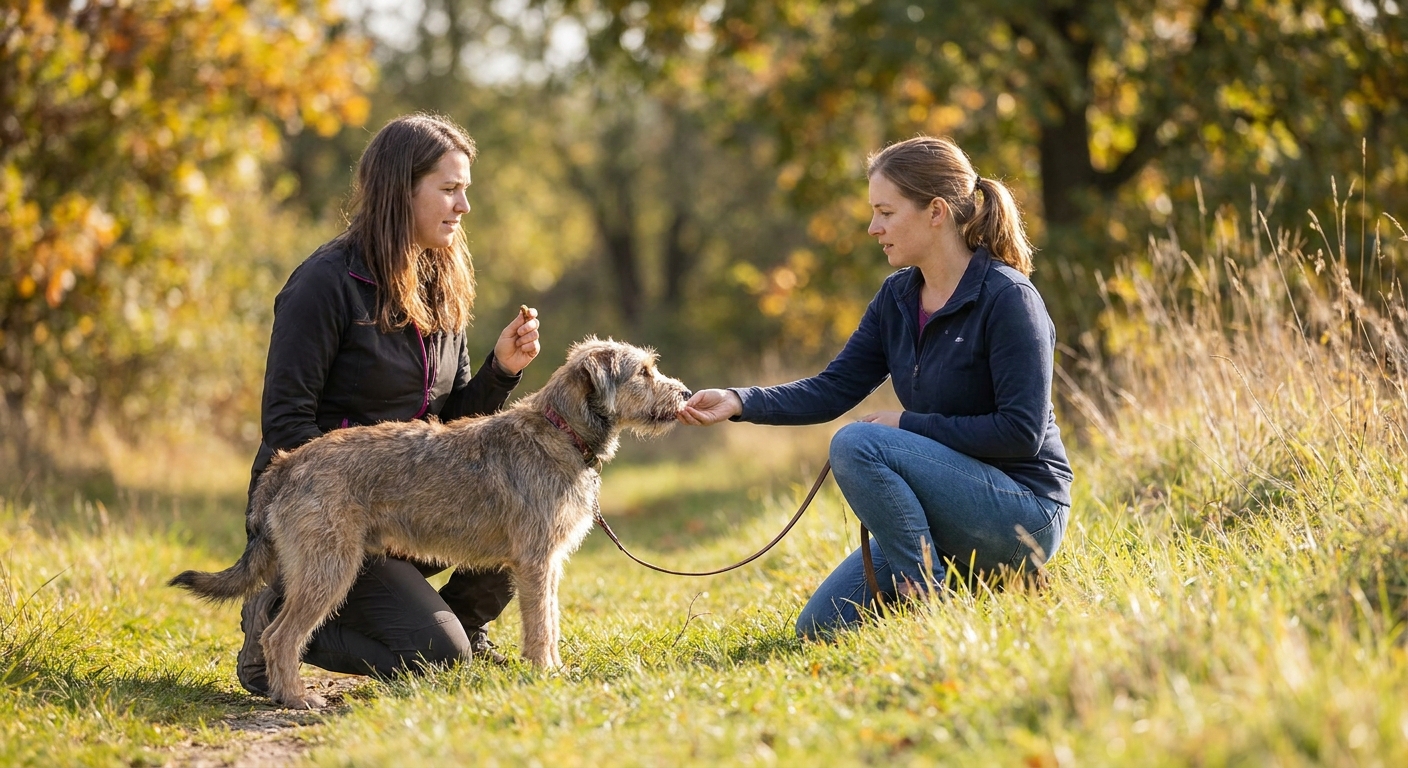
Six months in, the puppy who used to sit and wait at the door is now leaping the fence, ignoring recall in the park, and treating every dog walker on Ashtead Common as an old friend worth dragging you towards. That's adolescent dog training territory, and it's the stage that breaks more owners than the first eight weeks of puppyhood ever did.
- Adolescent dog training matters most between 6 and 18 months, when hormones and independence peak.
- Proud Dog’s 1:1 reward-based coaching is the safe pick for recall and lead-pulling regression in 2026 – Buy.
- Group puppy classes alone become a Skip once full adolescence hits; distractions need individual handling.
- Correction-based ‘dominance’ training is a Skip – it damages trust exactly when a dog needs it most.
- The teenage phase runs 6-12 months depending on breed size before real consistency returns.
Why this matters
Adolescence isn't bad behaviour, it's a developmental stage, and treating it like defiance is how good training relationships fall apart. Between roughly 6 and 18 months, a dog's brain is going through the canine equivalent of the teenage years: hormones shift, independence spikes, and the recall that was rock-solid at four months suddenly means nothing when a rabbit crosses the path in Epsom.
Owners across Surrey towns like Leatherhead, Cobham, Oxshott and Dorking tend to hit the same wall around the same time. The dog that walked nicely on a loose lead is now an Olympic sled puller. The one who greeted guests calmly is now a jumping, mouthing whirlwind. None of this means the earlier training failed – it means the dog has entered a new stage that needs a different approach, not more of the same.
Who this is for
This is for owners of dogs roughly 6 to 18 months old who are watching skills regress: recall that used to work, loose lead walking that's turned into a tug of war, jumping up that's got worse rather than better since the puppy phase. If you're standing in a field shouting a name into the void while your dog sprints the other way, this is your stage.
What to look for in adolescent dog training
Reward-based methods, not corrections
A dog in adolescence is more sensitive to pressure, not less, because trust is still being built. Correction-heavy methods might suppress a behaviour in the short term, but they tend to backfire by month twelve when the same dog starts avoiding the owner instead of checking in with them.
1:1 attention over group settings
Group puppy classes work well for early socialisation, but an adolescent dog struggling with recall or reactivity needs training built around their specific triggers, not a room full of distractions competing for attention. One-to-one work lets a trainer read what's actually happening in real time.
Real-world locations, not just a training room
A dog that sits perfectly in a quiet garden and ignores every cue on Epsom Common hasn't generalised the skill. Training that moves through parks, high streets and on-lead walks in places like Dorking or Oxshott builds behaviour that holds up where it actually matters.
Recall rebuilt from short distance up
Selective hearing at this age is textbook, not stubbornness. Recall work that starts at 5 metres on a long line and builds distance gradually, rather than jumping straight to off-lead freedom, is what actually sticks through the adolescent months.
Loose lead walking taught from scratch
Pulling gets worse in adolescence because the dog is stronger and more interested in the world. Loose lead work needs to be retaught with the dog's new size and confidence in mind, not just reinforced from puppyhood.
Coaching for the owner, not just the dog
The person holding the lead needs to understand why the dog is behaving this way and what to do about it in the moment. A programme that only works with the dog and sends the owner home with vague instructions rarely holds up once the trainer leaves.
Top approaches for adolescent dog behaviour
1:1 reward-based coaching – the safe pick. Sessions built around your dog's specific triggers, run in real locations, with the owner learning the mechanics alongside the dog. Proud Dog runs exactly this kind of 1:1 dog training and behaviour coaching across Ashtead, Epsom, Leatherhead, Cobham, Oxshott and Dorking, with recall, loose lead walking and jumping up as the most common adolescent issues booked in 2026. Verdict: Buy.
Structured recall-first work – the wildcard. Instead of tackling every issue at once, this approach isolates recall and drills it in stages: garden, quiet field, then busier spots with distractions. It's slower to show results across the board but the recall gains tend to be the most reliable of any method. Verdict: Consider.
Generic online group courses – the one to watch. Pre-recorded or livestreamed group classes can teach the theory well enough, but they can't watch your specific dog lunge at a cyclist and adjust in real time. Useful as a supplement, weak as the only tool for an adolescent dog with active behaviour problems. Verdict: Consider.
Correction-based or dominance-framed training – the one to avoid. Choke chains, alpha-rolls, and "showing the dog who's boss" might look like fast results on camera, but they tend to suppress the visible behaviour while increasing anxiety underneath it. This is the approach most likely to make a reactive adolescent worse by 18 months. Verdict: Skip.
“If your adolescent dog ignores every cue by month nine, that’s not defiance – it’s development, and it needs a different plan, not a louder voice.”
What to avoid
- One-off "miracle" sessions. A single session might calm things down for a week, but adolescent behaviour needs consistency over months, not a quick fix that fades by the next full moon of hormones.
- Training that only happens in the house. A dog that's perfect indoors and chaos on the lead outside hasn't actually learned the skill – it's learned the room.
- Ignoring the regression as "a phase that'll pass." Some skills do return on their own as the dog matures past 18 months to 2 years, but recall and reactivity issues left unaddressed tend to harden into habits rather than fade out.
Get help with your adolescent dog
1:1 reward-based training across Ashtead, Epsom, Leatherhead and Surrey.
Verdict comparison table
| Approach | Best for | Real-world generalisation | Verdict |
|---|---|---|---|
| 1:1 reward-based coaching | Recall, lead pulling, jumping up | High – trained in real locations | Buy |
| Structured recall-first work | Recall specifically | High for recall, narrow otherwise | Consider |
| Online group courses | Theory and reinforcement | Low without in-person practice | Consider |
| Correction-based training | Nothing recommended for adolescents | Poor – risks worsening anxiety | Skip |
FAQ
What age counts as adolescent dog training?
Adolescent dog training typically applies from around 6 months to 18 months old, though large breeds can stay in this stage closer to 2 years. This is when hormonal changes and growing independence cause previously solid skills like recall to fall apart.
Why has my dog’s recall got worse since puppyhood?
Recall regression in adolescence is normal and driven by hormonal shifts and rising confidence, not stubbornness. Rebuilding it with short-distance, low-distraction recall work before adding distance and distractions back in usually restores it within a few months.
Is group class or 1:1 training better for an adolescent dog?
1:1 training is generally better for adolescent dogs with active issues like reactivity or pulling, because a trainer can respond to your specific dog’s triggers in real time. Group classes work well for general socialisation but struggle with individual behaviour problems.
How long does the adolescent phase in dogs last?
Most dogs move through adolescence between 6 and 18 months, though it can run to 2 years in larger breeds. Consistent, reward-based training during this window shortens how long the difficult behaviours stick around.
Does correction-based training work for teenage dogs?
Correction-based training can suppress a behaviour temporarily but tends to increase anxiety in adolescent dogs rather than resolve the underlying cause. Reward-based methods are more likely to hold up once the dog matures past 18 months.
Can adolescent dog training fix jumping up?
Yes, jumping up in adolescent dogs is usually an excitement and greeting-manners issue that responds well to consistent reward-based redirection. It typically improves within weeks once the dog is taught and reinforced for an alternative greeting behaviour.
Where can I get adolescent dog training in Surrey?
Proud Dog runs 1:1 adolescent dog training and behaviour coaching across Ashtead, Epsom, Leatherhead, Cobham, Oxshott and Dorking. Sessions focus on recall, loose lead walking and jumping up in real-world locations rather than a training room.
One last thing
Most owners expect adolescent dog training to fix everything in a single session, and it doesn't – the dogs that come through the other side of this phase well are the ones whose owners kept practising in ordinary, boring moments: the school run, the bin day walk, the five minutes before dinner. That repetition, not any one clever technique, is what turns an 18-month-old with selective hearing into a dog you can actually trust off-lead by 2026's end.

