
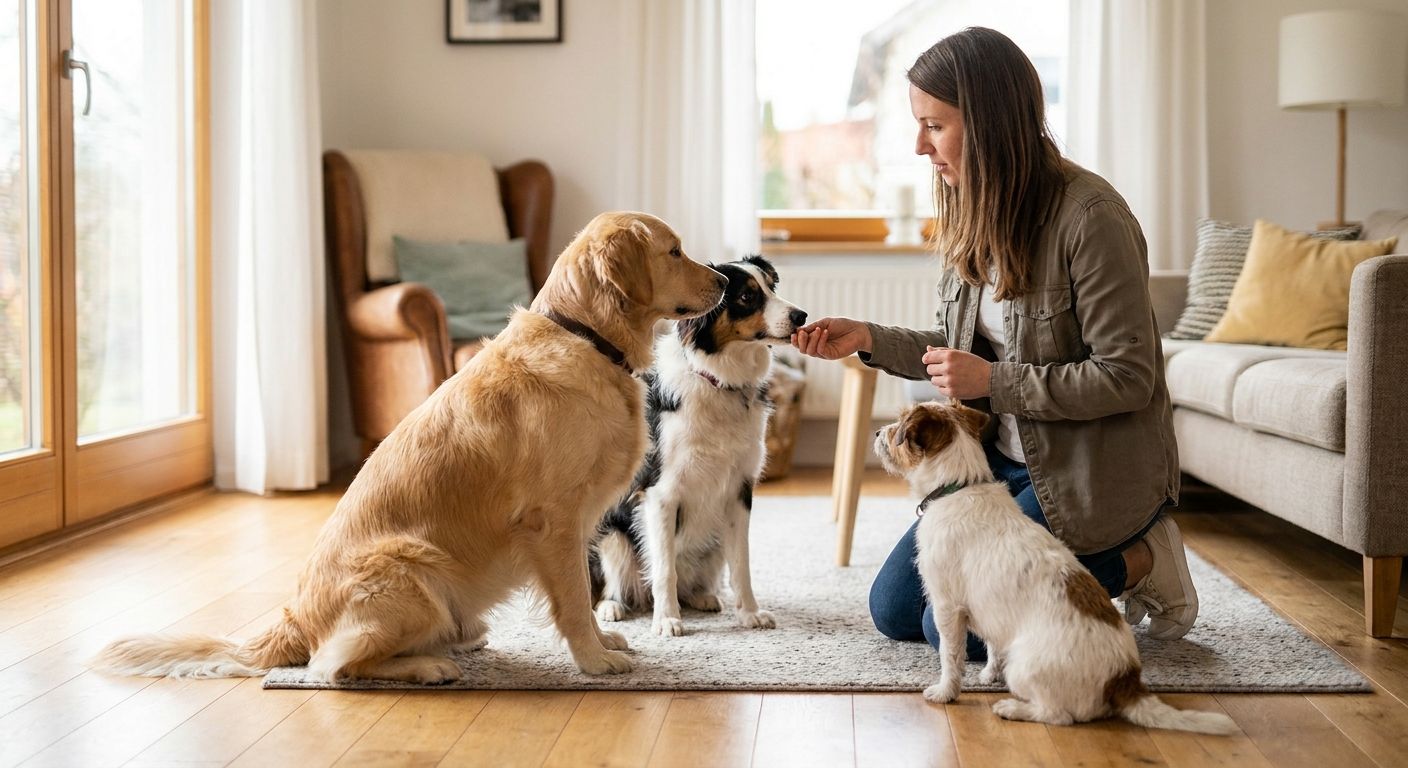
If you're living with two, three or more dogs and mealtimes feel like crowd control, this guide is for you: what actually works for training multiple dogs at once, and where trying to fix everything together backfires.
- Dog training for multi-dog households works best when each dog gets solo time before group work starts.
- Recall and loose lead walking need to be solid one-on-one before you ever clip two leads together.
- Resource guarding between housemates is the most missed problem in multi-dog homes across Surrey in 2026.
- Adolescent dogs (6-18 months) destabilise settled multi-dog households more than any other single factor.
- Group walks before individual skills are solid is the most common mistake owners make – and it’s avoidable.
Why this matters
Two dogs are not double the work – they're closer to four times the complexity, because now you're managing two individual dogs plus the relationship between them. I see this constantly across Ashtead, Epsom, Leatherhead, Cobham, Oxshott and Dorking: an owner who trained their first dog beautifully brings home a second, assumes the first will "show them the ropes", and six months later nobody can walk past the postman without a pile-up.
The dogs aren't broken. The training approach usually skipped a step. In 2026, the households that get this right treat each dog as an individual first and a pair or pack second – group harmony is the result of that groundwork, not a substitute for it.
Who this is for
This is written for owners with two or more dogs living together – whether that's a settled adult pair, a recent second-dog addition, or a household where one dog winds the others up every single evening. If your dogs are fine apart but chaos together, or fine together but one has started guarding the sofa, you're in the right place.
What to look for in dog training for multi-dog households
Individual sessions before joint ones
Every dog needs their own foundation – recall, a release cue, basic impulse control – built without the other dog in the room. Training two dogs together before either has these basics just teaches them to bounce off each other's arousal, which is the opposite of what you want.
A plan for resource guarding, not just food
Guarding shows up around beds, doorways, toys and even you – not only the food bowl. In multi-dog homes, a proper 1:1 dog training programme maps out management for all of these before it escalates into a fight, rather than reacting after the first one.
Recall that works with two dogs off lead
One dog with a shaky recall is inconvenient. Two dogs with a shaky recall, one of whom eggs the other on, is how you end up chasing them across a field in Bookham on a Tuesday morning. Recall training has to be tested with distractions, including the other dog, before you trust it off lead.
Loose lead walking on a double handle, not just single
Walking two dogs together is a different skill from walking one – your hands, your pace, your reactions to a squirrel all change. Loose lead walking needs to be solid with each dog solo before you attempt walking them as a pair, otherwise you're troubleshooting two problems at once.
Management for the adolescent phase
A settled two-year-old and a new eight-month-old puppy is a common combination that goes wrong fast. Adolescent dogs test boundaries, ignore cues they used to know, and can genuinely unsettle a housemate who was previously calm – this deserves its own plan, not "they'll grow out of it together".
A trainer who assesses the relationship, not just the dogs
Some trainers will happily book two individual assessments and never actually watch the dogs interact. What you need is someone who watches how they greet each other, share space and react under mild stress together, because that relationship data changes the plan.
Approaches worth prioritising
Individual recall foundation – the non-negotiable pick. Each dog needs a recall that holds under 2026's normal Surrey distractions – deer, other walkers' dogs, joggers – tested solo before it's tested as a pair. One in-context assessment session is usually enough to show you exactly where it breaks down. Buy this first, always, before anything group-based.
Resource guarding assessment – the one people skip. Most owners only notice guarding after the first real scuffle over a bed or a bone, by which point it's a habit rather than a one-off. A proper look at how your dogs interact around resources, mapped through reactive dog training support, catches it while it's still a management problem, not a safety one. Buy if you've ever seen a stiff body or a hard stare over a toy.
Adolescent-specific behaviour work – the wildcard. If one dog in your household is between roughly 6 and 18 months old, that dog is the variable destabilising the whole group, not the settled older dog. Behaviour training for adolescent dogs targets exactly this age window rather than treating the pup as a smaller version of your adult dog. Consider this if your "good" older dog has suddenly started reacting badly – the adolescent is usually the trigger.
Generic obedience classes with both dogs in the room – the one to skip. Group classes are built around one dog per handler learning alongside strangers' dogs, not around the specific relationship between your two housemates. It can work for basic manners but does nothing for guarding, jealousy or one dog winding the other up at home. Skip this as your only tool if the problems are happening between your own dogs, not with strangers' dogs.
What to avoid
- Walking both dogs together before either has a solid solo recall. It feels efficient but it means you're troubleshooting two dogs' distractions at once, and the calmer dog often absorbs the excitable one's habits rather than the reverse.
- Assuming the older dog will "train" the new one. Dogs learn some social rules from each other but not cues, recall or lead manners – that has to come from you, consistently, per dog.
- Fixing the visible fight without fixing the resource that caused it. Separating dogs after a scuffle over a chew stops that incident but leaves the guarding intact for the next high-value item that turns up.
Get a plan for your dogs together
A 1:1 assessment looks at each dog and how they interact as a pair.
Verdict comparison
| Approach | Best for | Verdict |
|---|---|---|
| Individual recall foundation | Every multi-dog household, no exceptions | Buy |
| Resource guarding assessment | Any sign of stiffness, staring or growling over items | Buy |
| Adolescent-specific behaviour work | Households with a 6-18 month dog and a settled older dog | Consider |
| Group walks before solo skills are solid | Nobody, yet – solo skills first | Skip |
| Generic group obedience classes only | Households with basic manners gaps, not relationship issues | Consider as add-on |
FAQ
What’s the best dog training approach for multiple dogs?
The best approach trains each dog individually first, then introduces joint work once solo recall and loose lead walking are solid. Skipping straight to group training in 2026 is the most common reason multi-dog households stall.
Is it harder to train two dogs than one?
Yes – two dogs together isn’t twice the training, it’s closer to four times the complexity because you’re also managing the relationship between them. Each dog still needs individual foundation work before joint sessions make sense.
How much does 1:1 dog training cost for a multi-dog household?
Costs vary by programme length and whether both dogs need individual sessions before joint work – it’s worth getting a specific quote for your household. Multi-dog plans typically cost more than single-dog training because each dog needs its own foundation work first.
Can two dogs be trained together from the start?
Not effectively – training two dogs together before either has basic recall and impulse control usually teaches them to feed off each other’s excitement instead. Solo sessions first, joint sessions once the basics hold under distraction, works far better.
Why does my older dog react badly since I got a second dog?
An adolescent dog (roughly 6 to 18 months) is the most common cause of a previously settled older dog becoming reactive at home. Targeted adolescent behaviour work usually resolves this faster than addressing the older dog’s reaction directly.
What is resource guarding between dogs in the same house?
Resource guarding is when one dog shows stiff body language, staring or growling to protect an item, space or person from a housemate. It shows up around beds, doorways and toys just as often as food, and it’s the multi-dog issue owners miss most often.
Do I need to walk my dogs separately or together?
Walk them separately until each has a reliable recall and loose lead skills on their own, then introduce joint walks gradually. Walking two dogs together before either skill is solid usually means neither dog’s manners improve.
Can a trainer work with both my dogs in one session?
Some sessions cover both dogs, but the useful ones also specifically watch how the dogs interact with each other, not just how each dog behaves alone. That relationship observation is what actually shapes a multi-dog plan.
One last thing
The household detail that changes everything is age gap, not breed or size – a settled adult dog paired with an adolescent under 18 months causes more multi-dog friction than any breed combination I see across Surrey in 2026. If your "good" dog has suddenly started reacting badly, check the calendar before you check the training: the timing usually lines up with the younger dog hitting adolescence.
Related guides
- Reactive dog training for Leatherhead owners
- Behaviour training for adolescent dogs
- Recall training for Surrey dog owners
- How to train your dog to walk on a loose lead

