
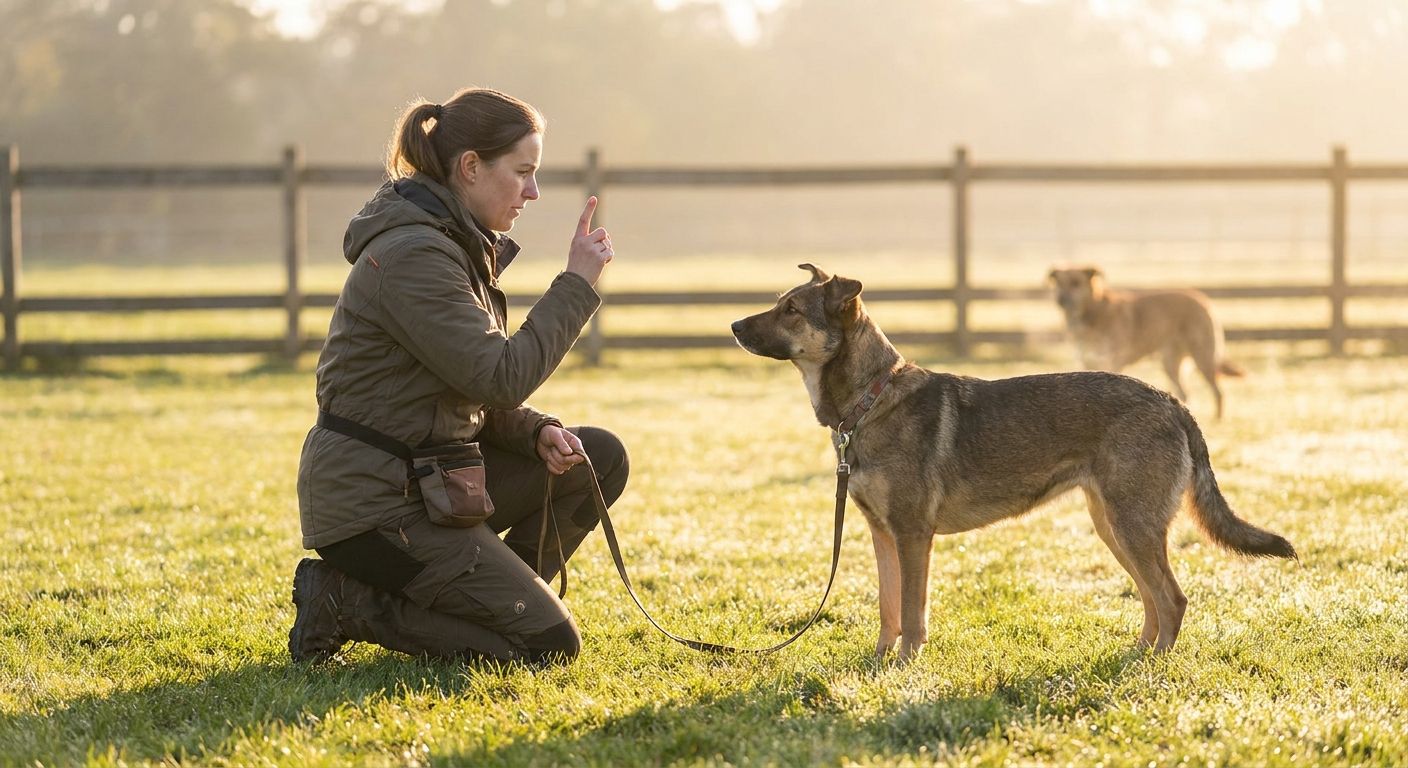
Reactive dog training methods range from calm, structured desensitisation to outdated correction-based techniques that can quietly make barking, lunging and growling worse. This guide ranks the reactive dog training methods actually used by qualified trainers in 2026, so you can pick one that fits your dog instead of guessing from a YouTube video at 11pm.
- Reward-based desensitisation and counter-conditioning is the strongest of the reactive dog training methods in 2026 – buy.
- BAT and 1:1 in-home sessions beat group classes for dogs who are genuinely over threshold, not just excitable.
- Aversive tools such as e-collars and prong corrections suppress warning signals without changing the underlying panic – skip.
- Board-and-train camps rarely transfer to the owner’s real-life handling – wait until you’ve seen the trainer work with you present.
- Rescue dogs with unknown history usually need home-based foundation work before any group setting – see a rescue-specialist route first.
Why this matters
A reactive dog isn't usually an aggressive dog. Most of the barking, lunging and screaming-into-the-void behaviour on lead is panic, not a genuine bite threat, and the method you choose either teaches the dog a calmer response or teaches it that the world really is that scary.
The wrong reactive dog training method doesn't just fail to help – it can actively escalate things. Flooding a dog with triggers it can't cope with, or punishing the growl that warns you a dog is uncomfortable, often produces a dog that skips the warning next time. That's the actual risk behind picking badly in 2026, when there's more conflicting advice online than ever.
Owners across Ashtead, Epsom, Leatherhead, Cobham, Oxshott and Dorking come to reactive dog training in Leatherhead after trying at least one approach that didn't stick. The pattern is consistent: methods built around distance, timing and reward hold up outside the training room. Everything else is a gamble on how well-supervised the dog is between sessions.
How this list was ranked
Each reactive dog training method below is assessed against three things: whether it teaches the dog an alternative behaviour rather than just suppressing the current one, whether it's safe for the dog's welfare over months rather than one walk, and whether the change actually holds up outside a controlled setting like a training field or a trainer's garden.
That framework tracks how ABTC and PACT-registered trainers in the UK approach behaviour work in 2026, and how reactive dog programmes are typically structured for Surrey households dealing with barking, lunging or fear-based reactions on lead.
The ranked list
1. Reward-based desensitisation and counter-conditioning – the gold standard
This pairs the trigger, seen at a distance the dog can cope with, with something the dog genuinely loves, then closes that distance in small steps. Most programmes start 8-10 metres from a trigger dog and work down gradually over 6-8 weeks.
It directly changes how the dog feels about the trigger rather than just stopping the reaction on the surface, which is why it holds up on ordinary walks, not just in a set-up training scenario. Full details on the approach sit on the reward-based training for anxious dogs page.
Verdict: Buy.
2. BAT (Behaviour Adjustment Training) – the slow-and-steady approach
BAT hands the dog some control: instead of the handler moving the dog away from a trigger, the dog is allowed to choose to disengage and is rewarded with distance itself. Sessions typically run 20-30 minutes and rely heavily on reading body language in real time.
It's a strong fit for dogs whose reactivity is driven by feeling trapped or crowded rather than pure excitement. It needs a trainer who can read subtle signals fast, which is why it's rarely a good solo-learning project.
Verdict: Buy.
3. 1:1 in-home sessions for nervous rescue dogs – the rescue specialist route
A large share of reactive dogs are rescues with an unknown or patchy history, and starting them straight into group settings or busy walks skips the foundation they actually need. Home-based work first, often 3-6 months before any real proofing around distractions, tends to produce a far more stable dog long-term.
This approach prioritises building confidence in a safe space before asking the dog to cope with the unpredictability of the outside world. See how it's structured on the training for nervous rescue dogs page.
Verdict: Buy.
4. Group "reactive dog" classes – the wildcard
These small, structured classes work several reactive dogs in parallel at a safe distance from each other, usually capped at 4-6 dogs per session. Done well, they're a good proofing step once a dog already has the basics of disengaging and refocusing.
Done too early, they can backfire – a dog that hasn't yet learned to look away from a trigger doesn't magically manage it better because other reactive dogs are in the room. The setting matters less than the sequencing.
Verdict: Hold until 1:1 foundations are in place.
5. Board-and-train camps – the outsourced fix
The dog goes away for two to four weeks, comes back apparently "fixed," and the owner is handed a list of cues to maintain it. The problem with reactivity specifically is that it's contextual – a dog that stops reacting to triggers with a stranger handler in a strange environment doesn't automatically stop reacting to the same triggers with you, on your street, on your lead.
Without the owner present to learn the handling and timing alongside the dog, the gains from a board-and-train often don't transfer home.
Verdict: Wait, or only consider it with heavy owner involvement built in.
6. Self-taught online courses and generic protocols – the DIY gamble
Fine for mild, occasional reactivity in an otherwise confident dog. Riskier for anything more, because most mistakes with reactive dogs happen in the first five seconds of a session – the moment you misjudge the trigger distance – and a video can't tell you that in real time.
A generic protocol also can't account for a dog's specific triggers, whether that's other dogs, joggers, or the postman.
Verdict: Hold, use as a supplement to guided work, not a replacement for it.
7. Aversive or "balanced" training – the one to skip
E-collars, prong collars and alpha-roll style corrections are built to stop the visible behaviour – the bark, the lunge – without addressing why the dog is doing it. Suppressing the warning signal doesn't remove the underlying fear or frustration, and in some cases removes the dog's early warning system altogether. Wales banned electronic training collars back in 2010, and scrutiny of aversive equipment across the rest of the UK has only increased since.
For a reactive dog specifically, where the goal is a calmer emotional response, punishing the outward sign of stress runs directly against what you're trying to achieve.
Verdict: Skip.
8. Vet behaviourist referral plus medication support – the medical backup
For dogs whose reactivity sits on top of a genuinely high baseline of anxiety, training alone can plateau. A referral through your GP vet to a clinical or veterinary behaviourist, sometimes alongside anxiety medication, can lower that baseline enough for the reward-based work to actually land.
This isn't a first step for every reactive dog, but it's the right call when a dog can't settle even in a low-trigger environment.
Verdict: Buy, for the specific cases it fits.
Comparison table
| Method | Best for | Time to see change | Verdict |
|---|---|---|---|
| Reward-based DS/CC | Most reactive dogs | 6-8 weeks | Buy |
| BAT | Dogs who feel trapped or crowded | Varies, ongoing | Buy |
| 1:1 home sessions for rescues | Rescues with unknown history | 3-6 months foundation | Buy |
| Group reactive classes | Proofing after foundations | Ongoing | Hold |
| Board-and-train | Rarely, without owner involvement | 2-4 weeks away | Wait |
| Self-taught online courses | Mild, occasional reactivity | Inconsistent | Hold |
| Aversive/balanced training | No reactive dog | N/A | Skip |
| Vet behaviourist + medication | High baseline anxiety cases | Alongside training | Buy |
How to find the right support
Getting the method right matters less than getting the right person delivering it. Three rules cut through most of the noise:
- Check for ABTC or PACT accreditation before booking anything – the qualities to look for in a Surrey dog behaviourist page covers what that actually means in practice.
- Be wary of anyone promising a fixed reactive dog in a set number of sessions – genuine behaviour change in 2026 still runs on the dog's timeline, not a package deadline.
- Start with an assessment, not a programme. A trainer who wants to see your dog's specific triggers before prescribing a method is doing it properly.
Get help with a reactive dog
1:1 reward-based sessions across Surrey, built around your dog’s triggers.
FAQ
What is the best training method for a reactive dog?
Reward-based desensitisation and counter-conditioning is the best-supported reactive dog training method in 2026, because it changes how the dog feels about a trigger rather than just suppressing the outward reaction. It works by pairing the trigger, seen at a manageable distance, with something the dog loves, then closing that gap gradually.
Is positive reinforcement enough for reactive or aggressive dogs?
Yes for most reactive dogs, where the barking or lunging is panic rather than a genuine bite risk. For dogs with a high baseline of anxiety, reward-based training paired with a vet behaviourist referral often works better than reward-based training alone.
Should I use an e-collar for dog reactivity?
No – e-collars and similar corrective tools suppress the warning signal without addressing the fear or frustration behind it. Wales has banned electronic training collars since 2010, and they’re not recommended for reactive dogs by ABTC-registered trainers.
How long does reactive dog training take?
Most reward-based programmes show measurable change within 6-8 weeks, though rescue dogs with unknown history often need 3-6 months of foundation work first. Full recovery to a fully relaxed dog around triggers can take longer and depends on the individual dog.
Can reactive dogs eventually be around other dogs?
Many reactive dogs can build up to calm coexistence with other dogs at a comfortable distance, though "cured" isn’t always the right expectation. Group reactive dog classes are a good proofing step once a dog has already learned to disengage from a trigger on its own.
Is group class or 1:1 training better for a reactive dog?
1:1 training is better as a starting point for genuinely reactive dogs because it lets the trainer control distance and timing precisely. Group reactive dog classes work well later, once the dog already has the basics of noticing a trigger and choosing to look away.
Do rescue dogs need a different approach to reactivity?
Often yes, because rescue dogs frequently have an unknown or patchy history that group settings and quick fixes don’t account for. Home-based foundation work before any exposure to busy environments tends to produce a more stable outcome.
How much does reactive dog training cost in the UK?
Cost varies by trainer, location and how many sessions a dog needs, so it’s worth checking current rates directly with a qualified trainer near you. What matters more than the headline price is whether the trainer is ABTC or PACT accredited and works from an assessment first.
One last thing
Most reactive dogs aren't dangerous – they're over threshold, and the barking is the dog's way of saying "get me out of this situation," not a warning of intent to bite. The single biggest predictor of progress isn't which of these reactive dog training methods you pick, it's whether you can spot your dog's early stress signals – a stiff body, a closed mouth, ears pinning back – before the trigger even gets close. Trainers can teach a method in an afternoon. Reading your own dog well enough to use it takes longer, and it's the part that actually changes the walks.
Related guides

