
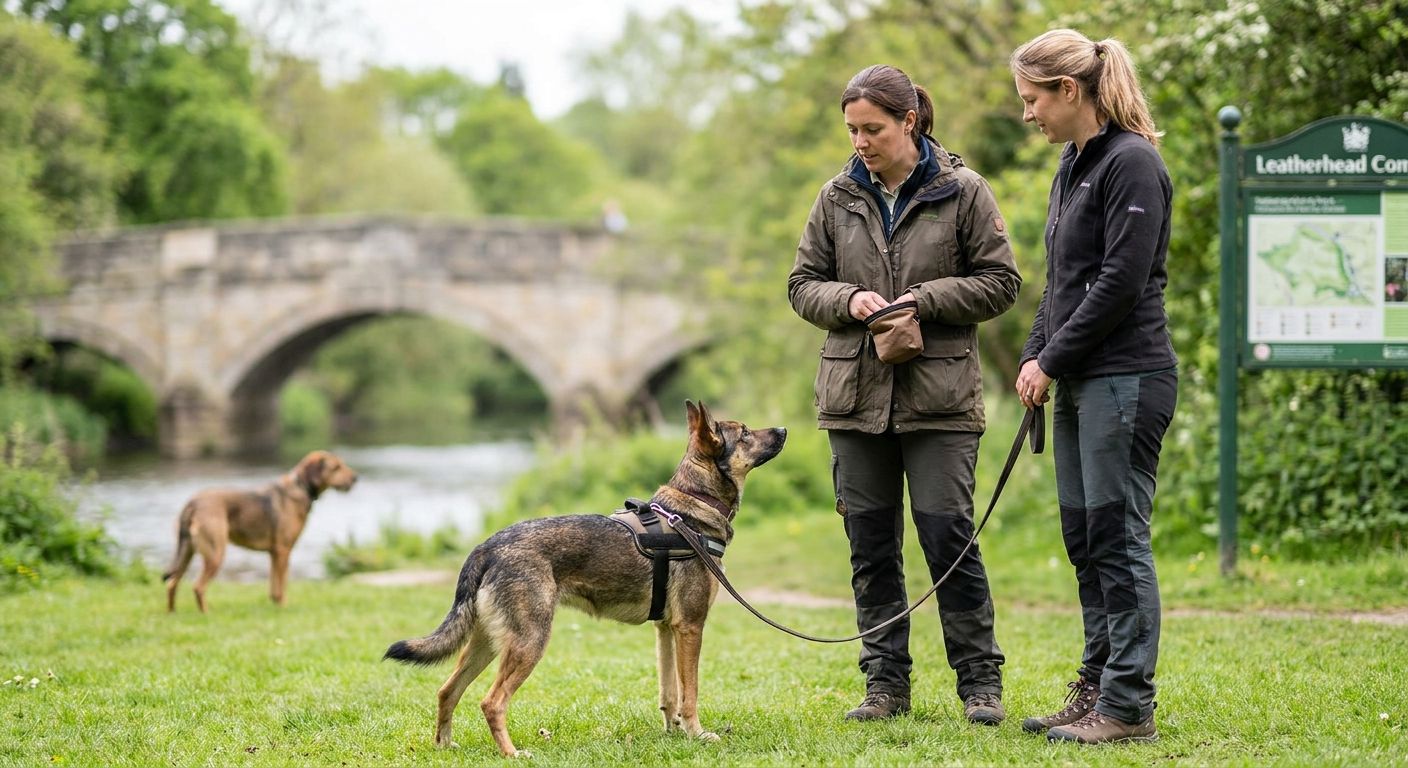
If your dog turns into a different animal the second another dog, jogger or cyclist appears, you're not alone — and you're in the right postcode to fix it. This guide breaks down what actually works for reactive dog training in Leatherhead in 2026, what to skip, and which local option gets picked most often by owners who've tried everything else first.
- 1:1 reward-based sessions in real Leatherhead locations beat generic group classes for reactive dogs — Buy.
- Board-and-train and quick-fix online courses skip the real-world practice reactive dogs need — Skip.
- Loose lead walking work should run alongside reactive dog training leatherhead owners book, not instead of it.
- Puppy-stage prevention work cuts the odds of reactivity developing later — Consider if your dog is under 12 months.
- Look for ABTC or PACT-listed trainers before booking anything in 2026 — it’s the fastest way to filter out unqualified advice.
Why this matters
Reactivity isn't naughtiness. It's a dog telling you, loudly, that it's over threshold — and the fix isn't a firmer voice or a stronger lead, it's changing what happens before the barking starts.
Leatherhead's mix of busy town-centre pavements, the river path, and open spaces like Cherkley Court means reactive dogs get triggered constantly without a plan. Owners who train in these exact spots in 2026 make faster progress than owners who only practise in a quiet garden and hope it transfers.
Who this is for
This is for the owner whose dog lunges, barks, freezes or spins at the sight of another dog on Church Street, whose walks have shrunk to 6am and 10pm to avoid other people, and who has already tried "just be firmer" and watched it make things worse. It's also for owners of young dogs showing the early signs — stiffening, staring, a slow build in barking at things that didn't used to bother them — who want to stop it becoming a habit rather than manage a full-blown problem later.
What to look for in reactive dog training for Leatherhead owners
Reward-based methods, not correction tools
Reactivity is usually fear or over-arousal, not dominance. A trainer reaching for a slip lead, prong collar or e-collar is treating the symptom by suppressing it, which tends to make the underlying stress worse even when the barking stops. Reward-based work changes the emotional response, which is the only fix that holds up outside the training session.
1:1 sessions before group classes
A reactive dog in a room full of other dogs is set up to fail before the class even starts. One-to-one sessions let a trainer control distance, exposure and pace to your dog's actual threshold, not a generic curriculum built for six different dogs at once.
Real-world locations, not just a training hall
A dog that behaves in a quiet studio and then loses it on the pavement outside Leatherhead station hasn't been trained for the world it lives in. Sessions that happen on actual local walking routes — the river, the Common, town-centre streets — build skills that transfer, because they were built in the place they need to work.
A trainer who explains the why, not just the what
If a trainer can't tell you why your dog reacts at 15 metres to some dogs and 3 metres to others, they're guessing at exercises rather than reading your dog. You want someone explaining threshold distance, body language and trigger stacking in plain terms, not jargon.
Realistic timelines, not overnight promises
Most reactive dog cases need a structured programme measured in weeks, not a single session. Anyone promising a fixed dog by next weekend is selling you something that won't last.
Checkable qualifications
Look for ABTC accreditation or PACT membership before you book. It's a two-minute check that filters out anyone relying on titles rather than actual training standards.
The options Leatherhead owners actually choose from
1:1 reward-based reactive dog training — the safe pick
Sessions run in real Leatherhead locations at a distance your dog can actually cope with, then close that gap gradually over a structured number of weeks. This is one-to-one dog training for Leatherhead dog owners built around your specific triggers rather than a fixed script. Verdict: Buy.
Loose lead walking work alongside reactivity training — the multiplier
A dog pulling toward every trigger has less impulse control to spare for managing its own arousal. Working on loose lead walking at the same time as reactivity work means calmer walks faster, because the two skills reinforce each other. Verdict: Buy.
Puppy-stage prevention work — the head start
Catching stiffening, staring or early barking at 4-8 months and addressing it before it becomes a rehearsed pattern is far easier than undoing months of practised reactivity in an adult dog. Verdict: Consider, if your dog is under 12 months and showing early signs.
Group reactive dog classes — the risky shortcut
These can work once a dog can already hold itself together at a set distance from other dogs, but most reactive dogs aren't there yet when owners book them. Too many owners start here first and see their dog's reactivity get worse, not better. Verdict: Consider, but only after 1:1 groundwork, never as a starting point.
Board-and-train — the skip
Sending a reactive dog away to be "fixed" and handed back trained looks efficient, but you're not in the room learning to read your own dog's threshold, so the skills don't transfer once you're the one holding the lead. Verdict: Skip.
Generic online courses and YouTube fixes — the wildcard that isn't
A video made for a generic dog in a generic garden doesn't account for your dog's specific triggers, your specific streets, or the fact that reactive dog cases need feedback and adjustment in real time. Verdict: Skip for anything beyond basic background reading.
What to avoid
- Aversive tools sold as a quick fix — prong collars, e-collars and spray collars can suppress the visible reaction while the underlying stress stays or worsens, which shows up later as a bigger problem.
- Flooding — deliberately exposing a reactive dog to a trigger up close "until it gets used to it" almost always makes reactivity worse, not better.
- Group classes as a first step — the instinct to socialise a reactive dog into calmness by throwing it into a room of dogs backfires more often than it helps.
Book 1:1 reactive dog training in Leatherhead
Sessions run on real Leatherhead walking routes, built around your dog’s actual triggers.
Verdict comparison
| Option | Real-world practice | Best for | Verdict |
|---|---|---|---|
| 1:1 reward-based training | Yes, on local routes | Any reactive dog, any age | Buy |
| Loose lead work alongside it | Yes | Dogs that pull toward triggers | Buy |
| Puppy prevention work | Yes | Dogs under 12 months, early signs | Consider |
| Group reactive classes | Partial, controlled | Dogs already coping at set distance | Consider |
| Board-and-train | No, you're not present | Nobody with a reactive dog | Skip |
| Online/YouTube-only | No | Background reading only | Skip |
FAQ
What’s the best reactive dog training in Leatherhead?
1:1 reward-based sessions run on real local routes are the strongest option for reactive dogs in Leatherhead in 2026, because they let a trainer control distance and exposure to your dog’s actual threshold rather than a fixed group class script.
Is 1:1 training better than group classes for a reactive dog?
Yes, for most reactive dogs, because 1:1 sessions control the distance from triggers that a dog can actually manage, whereas group classes put a stressed dog straight into close range with several others.
How long does reactive dog training take?
Most structured programmes run over several weeks rather than a single session, because reactivity is an emotional response that needs gradual, repeated practice at increasing difficulty to change.
Can a reactive dog be fully cured?
Most reactive dogs improve significantly and become manageable on normal walks, though many retain some sensitivity to specific triggers that needs ongoing awareness rather than disappearing completely.
Should I use a prong collar or e-collar for a reactive dog?
No — these tools can suppress the visible reaction without addressing the underlying fear or arousal, which often means the stress resurfaces later in a different way.
Is my puppy’s staring and stiffening a sign of future reactivity?
It can be an early warning sign, and addressing it at 4-8 months with structured puppy training is far easier than working with a fully rehearsed reactive pattern in an adult dog.
What should I check before booking a reactive dog trainer?
Check for ABTC accreditation or PACT membership and ask whether sessions happen 1:1 in real local locations, since both filter out unqualified advice and training that won’t transfer to your actual walks.
Does loose lead training help with reactivity?
Yes, because a dog straining toward triggers has less self-control available for managing its own arousal, so working on loose lead walking alongside reactivity training speeds up progress on both.
One last thing
The biggest predictor of progress isn't the dog's breed or bite history — it's whether training happens at the actual distance your dog can cope with. Owners who insist on closing the gap too fast in week one routinely see setbacks; owners who hold a boring, patient distance for longer than feels necessary see the fastest real change by week four or five.
Related guides
- Puppy training for Leatherhead families
- Dog behaviour training for Cobham dog owners
- Dog behaviour training for Oxshott dog owners

