
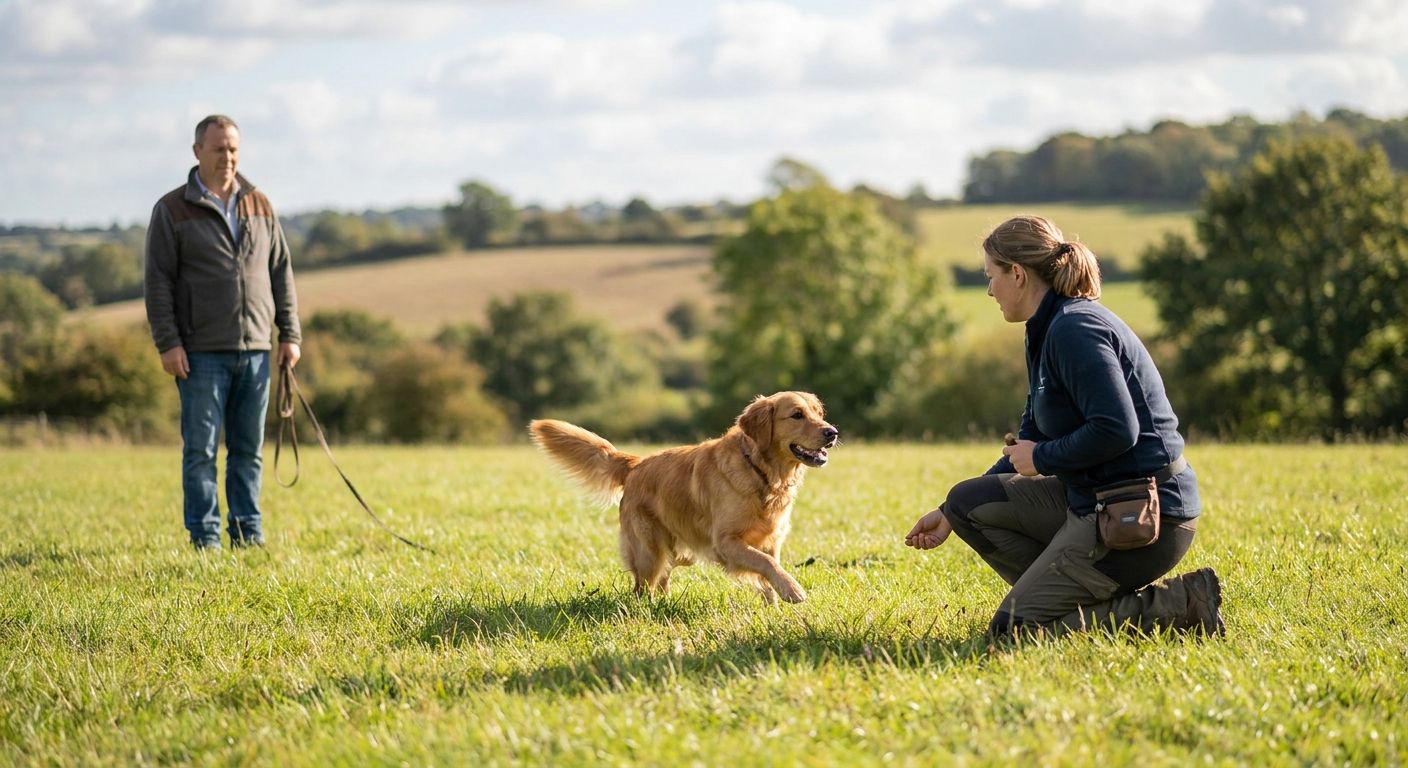
If your dog treats "come here" as a polite suggestion rather than an instruction, you're not imagining it — recall is the single most requested fix I see across Ashtead, Epsom, Leatherhead, Cobham, Oxshott and Dorking. This guide ranks the real options for fixing it in 2026, from private coaching to e-collars, and tells you which ones actually hold up once a squirrel crosses the path.
- 1:1 dog training for recall from Proud Dog wins for dogs with a genuine off-lead problem — Buy.
- Group recall classes suit confident dogs with mild issues — Hold, not a fix for chasing joggers or cyclists.
- E-collar recall training skips the root cause and often backfires long-term — Skip.
- Online recall courses work for prevention in young puppies, not for a dog already ignoring you mid-park — Wait.
- Board-and-train camps teach the dog to recall for a stranger, not for you — Skip.
Why this matters
A dog that won't come back past 10 metres of distraction isn't a lost cause — it's a skill that hasn't been built properly yet. Most owners have tried treats in the garden, a squeaky toy, maybe a long line, and it falls apart the moment there's a rabbit, a jogger, or another dog on the horizon.
That gap between "recalls in the kitchen" and "recalls at the park" is exactly what recall training for Surrey dog owners is built to close. It's not about a louder voice or a stricter tone — it's about rebuilding the behaviour in layers, starting low-distraction and working up to real-world chaos over a set number of sessions.
How this list is put together
Each option below is judged on four things that actually decide whether recall sticks: how well it proofs against real distractions (joggers, other dogs, food on the pavement), how fast it transfers from garden to park, whether it fits a normal working week, and whether the method stays reward-based rather than relying on fear or pain to suppress the behaviour. As an ABTC-registered trainer and PACT member, I weight ethical, reward-based approaches higher — a dog that recalls out of fear of a shock collar isn't recalling out of trust, and that difference shows up the first time the collar's off.
The ranked options for fixing recall in 2026
1. 1:1 reward-based recall coaching — the direct fix
This is coaching built around your actual dog and your actual park, not a generic script. Sessions run through the specific triggers that break your dog's recall — other dogs, food, joggers — in a set sequence, usually across 5 to 6 sessions, with homework between each one.
For owners in Ashtead, 1:1 sessions in Ashtead run on the same reward-based method, adjusted for your dog's history and the specific spots where recall tends to fail. It also fits around a normal working week — sessions are scheduled around a working schedule rather than expecting you to clear a Tuesday afternoon.
Verdict: Buy. This is the option that actually rebuilds the behaviour rather than managing around it.
2. Group recall classes — the social fix
Group classes run 6 to 8 dogs at a time, working recall in a shared space with moderate distraction. They're genuinely useful for a dog with mild recall wobbles who's already reasonably confident around other dogs.
They fall short for anything more serious — a class environment can't replicate the specific trigger that sends your dog sprinting toward the tree line, whether that's a spaniel with a nose or a terrier with prey drive.
Verdict: Hold. Fine as a top-up once the foundation is solid, not a starting point for a dog that already bolts.
3. Online recall video courses — the DIY option
Self-paced video modules work reasonably well for puppies under 6 months who haven't yet learned that running off is more rewarding than coming back. Once a dog has practised ignoring a recall cue in real distraction, a screen can't read your dog's body language or correct your timing.
Verdict: Wait. Use this for prevention in a young puppy, not as a fix once the habit's already formed.
4. Board-and-train recall camps — the outsourced fix
Your dog goes away for 2 to 3 weeks and comes back recalling for a trainer they've known for a fortnight. The problem is transfer: a dog that responds to an unfamiliar handler's voice and cues in an unfamiliar environment often reverts within days of coming home to your voice, your garden, your park.
Verdict: Skip. You end up paying twice — once for the camp, once for the 1:1 sessions needed to actually transfer it to you.
5. E-collar or remote-training recall — the shortcut that isn't
This suppresses the symptom rather than fixing the motivation behind it. A dog stops running toward the trigger because it's unpleasant to keep going, not because coming back has become more rewarding than the squirrel. Take the collar off and the underlying behaviour is often still there, sometimes worse, because the dog has learned to associate the collar itself with the cue rather than with you.
Verdict: Skip. It's the fastest-looking fix and the least durable one.
6. DIY treat-pouch practice — the free option
This works, but only if you already understand reinforcement timing, distraction ladders, and how to read your dog's stress signals before they bolt. Most owners who've reached the point of researching "1:1 dog training for recall" have already tried this route and hit a ceiling.
Verdict: Wait. Good as a maintenance tool once recall is already reliable, not as the primary fix.
What to avoid
- A trainer who won't explain their method in plain terms. If the answer to "how does this work" is vague, that's often covering for aversive tools dressed up in softer language.
- Any programme that skips distraction-proofing entirely. Recall that only works in a quiet garden isn't recall — it's a party trick.
- A one-size-fits-all six-week block with no adjustment for your dog. A nervous rescue and a confident adolescent Labrador need completely different pacing.
Comparison table
| Option | Best for | Distraction-proofing | Verdict |
|---|---|---|---|
| 1:1 reward-based coaching | Established recall problems | Strong — built around real triggers | Buy |
| Group recall classes | Mild wobbles, confident dogs | Moderate | Hold |
| Online video courses | Puppies under 6 months | Weak | Wait |
| Board-and-train camps | Owners wanting a quick handover | Weak once home | Skip |
| E-collar / remote training | Nothing, long-term | Suppresses, doesn't fix | Skip |
| DIY treat-pouch practice | Maintenance, not fixing | Depends entirely on owner skill | Wait |
Fix recall before the summer season
1:1 sessions across Surrey, built around your dog’s actual triggers.
Where to book
- Check for ABTC registration or PACT membership before booking anything — it's the fastest filter for reward-based versus aversive methods.
- Ask what a typical session looks like and whether it's tailored to your dog's specific triggers, not a fixed script run the same way for every dog.
- Confirm the trainer actually covers your town — a trainer working Ashtead, Epsom, Leatherhead, Cobham, Oxshott and Dorking knows the specific parks and distraction hotspots your dog will be tested against.
“A dog that recalls out of fear of a shock collar isn’t recalling out of trust, and that difference shows up the first time the collar’s off.”
FAQ
What’s the best 1:1 dog training for recall in 2026?
Reward-based 1:1 coaching that works through your dog’s specific triggers over a set number of sessions is the most reliable fix in 2026. It outperforms group classes, online courses and e-collars because it’s built around your dog’s actual environment, not a generic script.
Is 1:1 recall training better than group classes?
Yes for established recall problems, no for mild wobbles in an already-confident dog. Group classes work at moderate distraction; 1:1 sessions target the specific trigger, whether that’s joggers, food, or other dogs.
How long does recall training take?
Most 1:1 recall programmes run across 5 to 6 sessions, with homework between each one to bed in the behaviour before adding more distraction. Puppies with no existing bad habits often progress faster than adult dogs with an established pattern of ignoring recall.
Do e-collars work for recall?
E-collars suppress the behaviour rather than fixing the motivation behind it, so results often don’t hold once the collar comes off. Reward-based training builds a recall that’s more rewarding than the distraction, which lasts without equipment.
Can online courses fix a dog that already ignores recall?
Online courses work well for prevention in puppies under 6 months but rarely fix an established pattern of ignoring recall. A screen can’t read your dog’s body language or correct your timing the way 1:1 coaching can.
Is board-and-train worth it for recall?
Board-and-train camps often produce a dog that recalls for the trainer, not for you, because the behaviour was built with an unfamiliar handler in an unfamiliar environment. Transfer back to your voice and your park usually needs additional 1:1 sessions anyway.
How much distraction should recall training start with?
Recall training should start with minimal distraction, often just your garden or hallway, before adding distance and then real-world triggers like other dogs or food. Jumping straight to a busy park is the most common reason recall training fails.
Does recall training work for rescue dogs?
Yes, but pacing matters more than for a dog with no history — a rescue dog often needs extra time building trust before distraction work begins. A programme adjusted for a nervous rescue dog looks different from one built for a confident adolescent Labrador.
One last thing
The fastest recall gains often come from rewarding a dog with permission to go back to what it was doing — sniffing, chasing a scent, investigating a hedge — rather than just a treat. It's called the Premack principle, and in 2026 it's still the most underused tool in recall training: the dog learns that coming back doesn't end the fun, it just pauses it for a few seconds.
Related guides

