
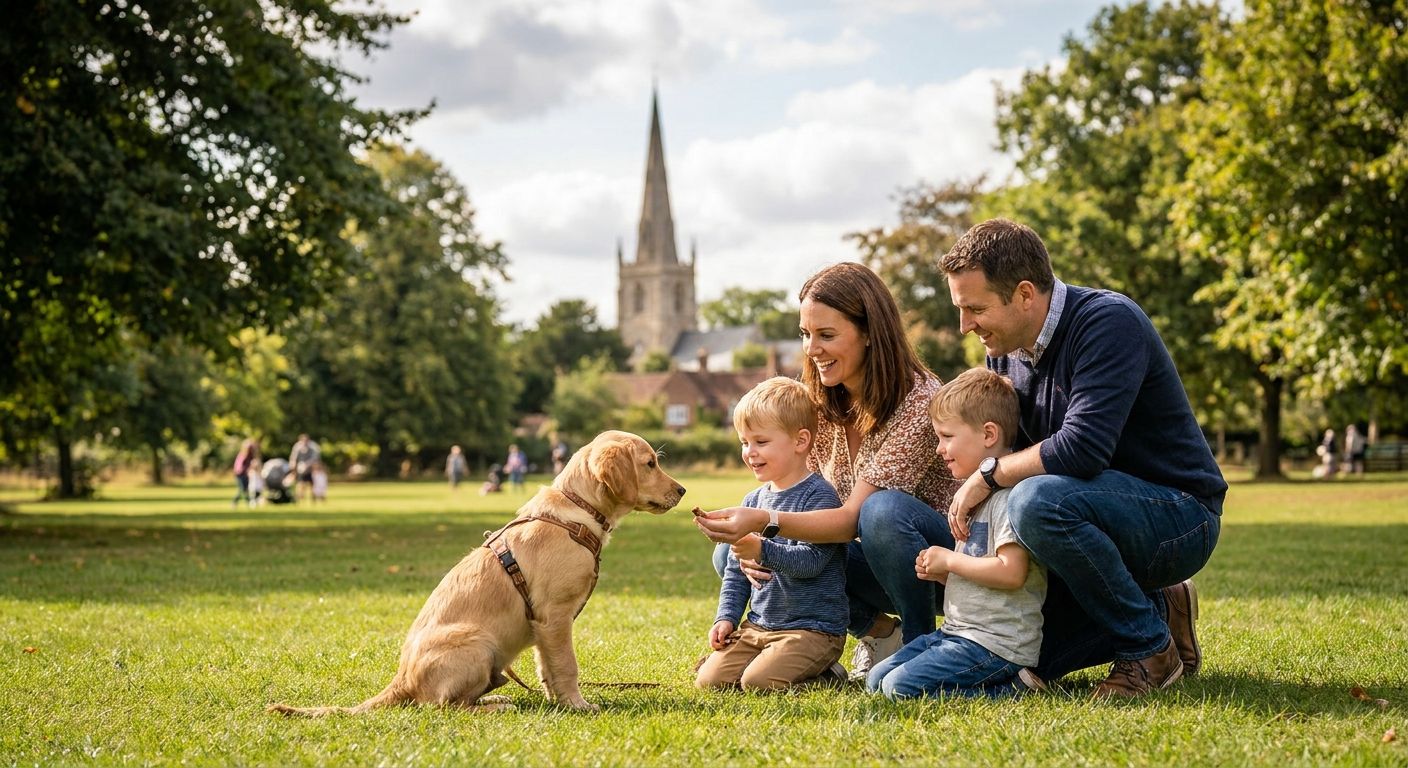
Bringing a puppy home in Ashtead means the next twelve weeks decide a lot: whether you get a dog who trots past the Common on a loose lead or one who drags you into the pond at Ashtead Park. This guide covers what actually matters when you're comparing puppy training for Ashtead families, and where 1:1 sessions with Proud Dog fit into that picture.
- Puppy training ashtead works best in-home during the 8-16 week socialisation window – start early, not after problems show up.
- Recall and loose lead walking matter more than sit and stay for a dog who’ll live off-lead near Ashtead Common.
- Group puppy classes alone rarely fix jumping up or pulling – one-to-one feedback closes that gap.
- Proud Dog’s Ashtead sessions cover recall, loose lead walking and jumping up in the home and outdoors – Buy for families wanting fast, targeted progress.
Why this matters
A puppy's brain is doing most of its social learning between 8 and 16 weeks old. Whatever your puppy practises in Ashtead this year, in 2026, sticks – the sniffing, the pulling, the jumping at visitors on the doorstep. Get ahead of it now and you're shaping habits instead of unpicking them later.
Families in Ashtead have a specific set of pressures that a generic training guide won't touch: dog walkers converging on the Common at the same hour, school-run traffic near the station, and gardens that back onto footpaths where a bolting puppy meets a jogger fast. Training that ignores your actual streets and routines wastes your first few months.
Who this is for
This is for Ashtead households with a puppy under six months, or one that's just arrived, who want a plan built around local walking routes rather than a generic obedience script. It's also for families who've tried a six-week group class and found their puppy still bolts at the front gate or throws itself at every visitor. If that's you, one-to-one puppy training in Ashtead is built around exactly that gap.
What to look for in puppy training for Ashtead families
Sessions that happen in your home and on your streets
A puppy that sits nicely in a hired hall doesn't automatically sit nicely by your own front door. Training delivered where you actually live – kitchen, garden, the walk to Ashtead Common – transfers faster because the puppy learns the behaviour in the context it needs it.
Recall work that starts before your puppy needs it
Recall is the one skill that keeps a puppy safe once the lead comes off, and Ashtead has enough open green space that owners want off-lead time early. Training that builds recall from week one, rather than bolting it on after a scare, gets you there faster and with less stress.
Loose lead walking taught as its own skill
A puppy that pulls like an Olympic sled dog on a 20-minute walk isn't being naughty – it's never been taught an alternative. Look for a programme that treats loose lead walking as a dedicated skill with its own steps, not a side note in a general obedience session.
A plan for jumping up and door manners
Visitors, deliveries, the school run – Ashtead homes get a steady stream of doorbell moments, and a puppy that learns to jump now will still be jumping at 30kg later. Training that addresses greeting behaviour specifically, rather than a blanket "no" command, actually changes the habit.
Reward-based methods, not correction-based ones
Puppies learn faster and with less fallout from training that rewards what you want rather than punishing what you don't. If a programme leans on choke chains, prong collars or "dominance" language, that's a signal to look elsewhere – the science on this has moved on, and so should the method.
Flexibility around your puppy's actual age and temperament
An 8-week-old puppy needs different handling from a 14-week-old adolescent already testing boundaries. A one-size plan that doesn't flex for age, breed or confidence level will fit some puppies and fail others.
The training options for Ashtead puppies
Puppy Foundations – the safe pick. Covers house-training, socialisation and basic handling for pups between 8 and 16 weeks. One concrete number: this window closes fast, and most of a puppy's lifelong social confidence is set inside it. Buy if your puppy is under four months old.
Recall Training – the one that pays off longest. Builds off-lead reliability in stages, starting in the garden before moving to Ashtead Common. Owners who skip this in year one often spend years managing a dog who won't come back. Buy if you want off-lead walks without the panic.
Loose Lead Walking – the fix for daily frustration. A dedicated session that breaks pulling down into rewarded steps rather than a single correction. If your puppy has already learned that pulling gets it where it wants to go, this is the pick that undoes that habit before it hardens. Consider if walks currently feel like a tug-of-war.
Jumping Up & Manners – the doorstep fix. Targets greeting behaviour with visitors, family and other dogs, using reward timing rather than shouting. Consider if your puppy launches at everyone who walks through the door.
Generic six-week group class – the wildcard that often disappoints. Useful for basic socialisation with other puppies but rarely gives individual feedback on recall, pulling or jumping. Skip it as your only training if any of those three issues are already showing up.
Book 1:1 puppy training in Ashtead
Sessions at home and on your local walks, built around your puppy’s age and habits.
What to avoid
- Correction-heavy methods dressed up as "balanced training" – if a trainer's first tool is a check chain or a spray bottle, that's a workaround for a training gap, not a fix for it.
- Online-only puppy courses with no live feedback – a video can't tell you why your puppy is jumping at 4pm specifically, and it can't adjust when the plan isn't working.
- Waiting past 16 weeks to start anything structured – the socialisation window doesn't reopen, and habits formed by default (pulling, jumping, ignoring recall) take far longer to unlearn than to prevent.
Verdict comparison
| Programme focus | Best for | Format | Verdict |
|---|---|---|---|
| Puppy Foundations | New pups, 8-16 weeks | 1:1 in-home | Buy |
| Recall Training | Off-lead confidence on the Common | 1:1 outdoor sessions | Buy |
| Loose Lead Walking | Pulling on daily walks | 1:1 walk-based session | Consider |
| Jumping Up & Manners | Visitors and doorstep chaos | 1:1 in-home session | Consider |
| Generic group class | Basic socialisation only | 6-8 week group course | Skip |
For families dealing with more established behaviour – reactivity, resource guarding, or a jumpy adolescent past the puppy stage – the same reward-based approach extends into behaviour training for Oxshott dog owners, which covers a lot of the same ground for slightly older dogs.
FAQ
What’s the best puppy training for Ashtead families in 2026?
One-to-one sessions delivered in your home and on your local walking routes work best in 2026, because they teach recall and loose lead walking in the exact places your puppy will use them. Generic group classes can help with early socialisation but rarely fix pulling or jumping on their own.
How much does 1:1 puppy training cost in Ashtead?
Cost depends on how many sessions your puppy needs and which behaviours you’re addressing, so it’s worth checking current rates directly. Most families budget for a short block of sessions covering foundations, recall and loose lead walking together.
Is 1:1 training better than group puppy classes?
For fixing specific problems like pulling or jumping up, yes – 1:1 sessions give feedback tuned to your puppy’s exact triggers. Group classes still have value for early socialisation with other puppies, just not as a standalone fix.
How early should puppy training start?
Start as soon as your puppy comes home, ideally inside the 8-16 week socialisation window. Waiting until problems appear means unlearning a habit instead of preventing one, which takes longer.
Does puppy training cover recall and loose lead walking together?
Yes, most Ashtead programmes bundle recall and loose lead walking because they’re both needed for safe off-lead time on Ashtead Common. Training them separately just delays the point where walks stop being a tug-of-war.
What areas near Ashtead does Proud Dog cover?
Proud Dog runs 1:1 sessions across Ashtead and nearby Surrey towns including Leatherhead, Epsom, Cobham, Oxshott and Dorking. Sessions happen in the owner’s home and on local walking routes rather than a fixed venue.
How long before puppy training shows results?
Simple wins like reduced pulling can show within a few sessions once the puppy understands what’s being rewarded. Recall reliability and full impulse control around visitors typically take longer and depend on consistent practice between sessions.
Can jumping up be fixed without shouting or dominance training?
Yes – reward-based methods that ignore the jump and reward calm greetings work faster than punishment-based corrections. Shouting or physical corrections often just add excitement or fear to an already overstimulated puppy.
One last thing
The families who see the fastest change in 2026 aren't the ones who book the most sessions – they're the ones who practise recall in the garden for five minutes before every walk, every single day, whether or not a trainer is watching. Consistency between sessions matters more than the sessions themselves.
Related guides

