
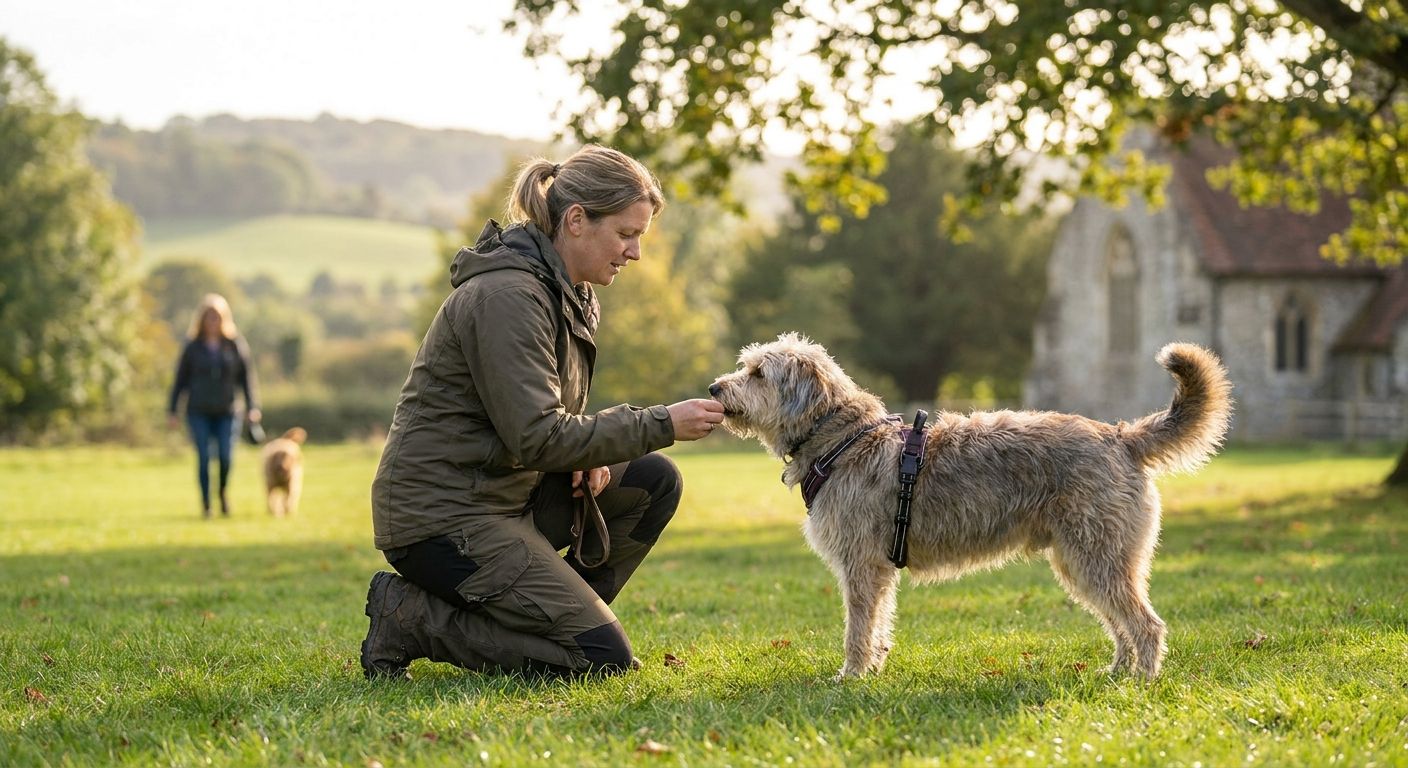
If your dog turns into a lunging, barking mess every time a cyclist, another dog, or a pram appears on Rose Hill or the paths around Denbies, you're not doing anything wrong — reactive dog training in Dorking exists precisely because this is one of the most common behaviour issues owners bring to a trainer.
- One-to-one, reward-based sessions beat group classes for reactive dogs because triggers can be controlled at a distance the dog can cope with.
- Reactive dog training in Dorking works fastest when it starts at home, not at the busiest dog-walking spot in town.
- Puppy foundations reduce the odds of reactivity showing up later — start before six months where you can.
- Avoid tools and quick-fix classes that suppress barking rather than change how the dog feels about the trigger — that’s a Skip, not a Buy.
Why this matters
Reactivity isn't naughtiness. It's a dog whose nervous system has decided that a trigger — another dog, a jogger, a delivery van — is a threat worth shouting at before it gets close enough to be a problem. Left alone, it tends to get worse, not better, because every successful "scare-off" teaches the dog that barking works.
The fix isn't obedience drilling. It's changing how the dog feels about the trigger in the first place, and that's a different skill set from teaching a sit or a stay. Reward-based, force-free reactive dog training in Dorking works on that emotional layer directly, which is why it holds up better long-term than corrections or gadgets.
Who this is for
This guide is for Dorking owners whose dog is fine at home and turns into a different animal on the lead — the ones who've started avoiding certain streets, certain times of day, or the school run because they can't predict what will set their dog off. It's also for owners of younger dogs showing the early signs (stiffening, staring, a low growl) who want to get ahead of it before it becomes a full lunge-and-bark routine.
What to look for in reactive dog training for Dorking owners
One-to-one over group classes
A reactive dog in a room full of other dogs is a dog set up to fail. One-to-one sessions let a trainer control distance and pace — the two things that actually determine whether a dog can learn anything in the moment, rather than just rehearsing the reaction.
Force-free, reward-based methods
Any approach built on corrections, e-collars, or dominance language treats the symptom, not the cause. It might suppress the bark for a few weeks; it does nothing for the underlying fear or frustration, and in 2026 the evidence for reward-based methods outperforming aversive ones on long-term outcomes is well established in the training world.
Training that happens in real Dorking locations
A programme that only ever runs in a quiet garden won't transfer to Rose Hill on a Saturday morning. Look for sessions that move into the actual streets, parks, and pavements where the reactivity shows up — that's where the learning has to stick.
A plan for loose lead walking alongside the reactivity work
A dog that's already pulling hard on the lead has less capacity to cope with a trigger appearing — tension on the lead and stress feed each other. A loose lead walking guide run alongside reactivity work gives the dog more room to think before it reacts.
Support that doesn't blame you
Owners of reactive dogs get a lot of unhelpful advice from strangers on walks. Good training support is non-judgemental — it focuses on where you're going from here, not on what's gone wrong so far.
Realistic timelines, not overnight promises
Reactivity built up over months or years doesn't unwind in one session. Anyone promising an instant fix is either overselling or using methods that suppress the behaviour rather than change it.
“If your dog can’t take a treat past the trigger, you’re too close — back up before you try anything else.”
Top picks for Dorking owners dealing with a reactive dog
1. One-to-one reactive dog training in Dorking — the safe pick
Hook: sessions built entirely around your dog's specific triggers, run in and around Dorking. The spec that matters: distance-controlled exposure, meaning the trainer works below your dog's reaction threshold rather than pushing through it. This is the approach with the strongest track record for genuine, lasting change in reactive dogs across 2026 and prior years. Verdict: Buy.
2. Loose lead walking work paired with reactivity training — the fix for pavement pulling
Hook: this addresses the physical tension that makes reactivity worse. The number that matters here is distance — a dog pulling hard has less spare attention to notice a trigger early and choose a different response. Pairing the loose lead walking guide with reactivity sessions gives faster, more stable progress than tackling either issue alone. Verdict: Buy.
3. Puppy foundations for Dorking families — the head start
Hook: catching the early signs of reactivity in a young dog before six months old changes the whole trajectory. If you've got a puppy already showing stiffening or barking at strangers, puppy training for Dorking families gets ahead of the pattern instead of undoing it later. Verdict: Consider if your dog is under a year — this is prevention, not a cure for an established adult reactivity pattern.
Book a session for your reactive dog
One-to-one, reward-based support for Dorking owners.
What to avoid
- Group reactive dog classes — putting a reactive dog in a room with several unfamiliar dogs looks efficient but usually sets the dog up to rehearse the exact behaviour you're trying to change.
- Aversive tools sold as "quick fixes" — e-collars, prong collars, and spray devices can suppress the bark while leaving the underlying fear or frustration untouched, and often make it worse once the tool comes off.
- Online-only courses with no in-person feedback — reactivity work depends on reading body language in real time and adjusting distance on the fly. A video course can't do that for you on a Dorking pavement.
Verdict comparison
| Approach | Best for | Session location | Verdict |
|---|---|---|---|
| One-to-one reactive dog training | Established reactivity in adult dogs | Home + real Dorking streets | Buy |
| Loose lead walking + reactivity work | Dogs that pull hard and react | Home + local walks | Buy |
| Puppy foundations | Dogs under 12 months showing early signs | Home + gentle exposure | Consider |
| Group reactive classes | Rarely the right fit for true reactivity | Training hall | Skip |
| Aversive tools/e-collars | Not recommended for reactivity | N/A | Skip |
FAQ
What is reactive dog training and how is it different from obedience training?
Reactive dog training changes how a dog feels about a trigger — another dog, a jogger, a cyclist — rather than just teaching commands. Obedience training teaches skills like sit and stay, but a dog can be fully obedient at home and still lunge and bark at triggers on a walk.
Is reactive dog training in Dorking available as one-to-one sessions?
Yes, one-to-one sessions are the standard approach for reactive dogs because they let a trainer control distance from the trigger, which group classes can’t do. This matters because a reactive dog placed too close to other dogs too soon usually just rehearses the reaction.
How long does it take to see results with a reactive dog?
Progress depends on how long the pattern has been established and how consistently the work continues between sessions. Owners who practise the plan daily between sessions in 2026 tend to see change faster than those who only work on it during the session itself.
Can puppy training prevent reactivity later on?
Early, gentle exposure and confidence-building work in puppyhood reduces the odds of reactivity developing, though it isn’t a guarantee. Catching stiffening, staring, or early barking in a young dog and addressing it early is far easier than undoing an established adult pattern.
Is force-free training effective for reactive dogs?
Yes — reward-based, force-free methods address the underlying fear or frustration driving the reaction rather than just suppressing the bark. Corrections and aversive tools can quiet a dog short-term but tend to leave the root cause untouched.
Do I need special equipment for a reactive dog?
No special equipment is required; a well-fitted harness and a comfortable lead are usually enough. What matters far more than gear is managing distance from triggers and having a clear plan for what to do when one appears.
What triggers cause dog reactivity most often?
Other dogs, joggers, cyclists, and unfamiliar people approaching quickly are among the most common triggers reported by owners. The specific trigger matters less than the distance at which the dog starts reacting — that’s the number a trainer works from.
How much does reactive dog training cost in Surrey?
Cost varies by programme length and how many sessions your dog needs, so it’s worth checking current pricing directly rather than assuming a fixed figure. One-to-one work is generally priced per session or as a short programme rather than a single flat fee.
One last thing
The single biggest mistake Dorking owners make isn't picking the wrong method — it's practising in the wrong place. Working on reactivity in a quiet garden and then testing it for the first time on a busy Saturday morning walk on Rose Hill skips every step in between. Progress happens in small, boring, repeated exposures at a distance the dog can actually cope with, not in dramatic breakthroughs.
Related guides
- Loose lead walking guide
- Puppy training for Dorking families
- One-to-one dog training for Leatherhead dog owners
- Dog behaviour training for Oxshott dog owners

